


South Korea's elder care workers are burning out. A small program in Pocheon is asking a long-overdue question.
POCHEON, South Korea — The work begins before most people are awake.
A care worker arrives at a senior's home, helps with the morning routine — dressing, washing, the slow negotiation of a body that no longer cooperates the way it once did. She assists with breakfast, monitors for signs of a fall, manages the particular unpredictability that comes with cognitive decline. By the time she leaves, she may have absorbed more emotional weight than she will ever be asked to account for.
Then she goes to her next client.
South Korea's long-term care system depends, at its foundation, on workers like her — the roughly 500,000 certified care workers, known as yoyang bohosa, who provide hands-on support to the country's rapidly expanding elderly population. As the nation crosses the threshold into what demographers call a "super-aged society" — one in which more than 20 percent of the population is over 65 — their role will only grow more essential.
Yet for all their centrality to the system, these workers have rarely been asked a simple question: How are you doing?
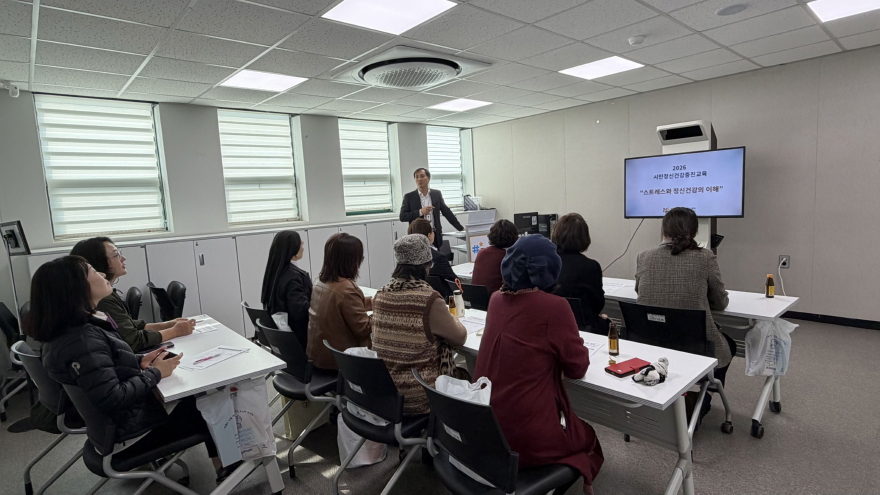
Last week, the Pocheon Mental Health and Welfare Center took a modest but meaningful step toward answering it. Ten care workers gathered for a session titled "Understanding Stress and Mental Health" — a program designed not for the elderly residents they serve, but for the workers themselves.
It was, by any conventional measure, a small event. Its implications are considerably larger.
The Hidden Cost of Caring
The physical demands of elder care are well documented. Repeated lifting, transferring, and assisting with mobility place severe strain on the musculoskeletal system. Injury rates among care workers are high, and chronic pain is common.
Less visible, but no less real, is the psychological toll.
Care workers operate in sustained proximity to suffering. They witness the gradual diminishment of people they have come to know. They absorb frustration, confusion, and grief — sometimes directed at them — as a routine feature of the job. They are expected to maintain warmth and patience through conditions that would test anyone's composure.
This is emotional labor in its most demanding form. And it is performed, in South Korea as elsewhere, largely by middle-aged women in precarious employment, earning wages that do not reflect the complexity or the consequence of what they do.
"The mental health of care workers is not simply a matter of individual well-being," said the deputy director of the Pocheon center, who helped organize the program. "It is directly connected to the quality of care that elderly residents receive. A worker who is exhausted and depleted cannot sustain the kind of presence that good care requires."
The logic is straightforward, and yet it has taken years to gain traction in policy circles: you cannot build a sustainable care system on the silent suffering of its workforce.
A Curriculum for the Overlooked
The session in Pocheon was structured around three interlocking themes: the nature of stress and its physiological effects; the patterns of distorted thinking — what psychologists call cognitive errors — that can deepen emotional distress; and practical strategies for managing both.
The inclusion of cognitive error patterns is worth noting. In the context of care work, these distortions take recognizable forms. I should have done more. She seems to dislike me. I'm not suited for this work. Such thoughts, repeated over months and years, can quietly erode a worker's sense of competence and worth, accelerating the trajectory toward burnout.
Teaching workers to recognize these patterns — to name them, examine them, and interrupt them — is a form of psychological literacy that has historically been reserved for those with access to formal therapy. Bringing it into a community education setting, for workers who are unlikely to seek clinical support on their own, represents a meaningful democratization of mental health resources.
One participant, speaking after the session, offered a sentence that captured something essential about the lives of those in the room.
"I've been so focused on caring for the elderly," she said, "that I never had the space to look at my own mind."
The Limits of a Single Afternoon
To report on this program without acknowledging its limitations would be to do it a disservice.
Ten participants. One session. A single afternoon carved out of schedules that leave little room for reflection.
The Pocheon center has, since 2023, expanded its mental health offerings considerably — operating community counseling spaces, evening consultation services, disaster psychological support, and subsidized treatment programs. This latest initiative extends that reach to a specific occupational group that has long been underserved. That is genuine progress.
But the structural conditions that produce burnout among care workers — the physical intensity of the labor, the emotional demands, the low wages, the job insecurity, the persistent social undervaluation of care work — are not addressed by a morning seminar, however well designed.
This distinction matters enormously. There is a risk, in programs of this kind, that the message received is not the system needs to change but rather you need to manage yourself better. Mental health education, if it is not accompanied by material improvements in working conditions, can inadvertently shift the burden of a structural problem onto the individuals who are already bearing it most heavily.
The center's leadership appears aware of this tension. But awareness is not policy. And policy, in this domain, has been slow.
What Comes Next
For the program to fulfill its potential, three things are necessary.
The first is scale. Ten workers in a single session is a beginning, not a solution. Reaching the full population of care workers in Pocheon — let alone across Gyeonggi Province or the country — will require mobile outreach, facility-based programming, and digital delivery. The infrastructure exists, in many cases. The will to deploy it consistently is what has been lacking.
The second is continuity. Stress, depression, and occupational burnout are not resolved by a single encounter with useful information. They require ongoing support: regular group sessions, peer networks, accessible counseling, and the kind of sustained relationship that allows trust to develop over time. Mental health, as practitioners in the field consistently emphasize, is maintained through connection and repetition, not through one-time instruction.
The third — and most consequential — is structural reform. Wages for care workers in South Korea remain low relative to the demands of the work. Employment is often precarious. Social recognition is limited. No amount of stress management training will compensate for conditions that are, by any reasonable standard, inadequate. Mental health support and labor reform are not alternatives. They are complements, and both are necessary.
The scope of the problem, moreover, extends beyond yoyang bohosa alone. Social workers, disability support workers, child care providers — the entire ecosystem of care labor in South Korea carries a similar psychological burden. A serious national response would address all of them.
The Arithmetic of Care
There is a simple logic at the center of this conversation, and it is worth stating plainly.
The quality of care that elderly people receive is inseparable from the condition of the people who provide it. A care system that extracts the maximum from its workers while investing minimally in their well-being is not a sustainable system. It is a system that is slowly consuming itself.
Pocheon's program is small. But the question it is asking — do we care for the people who care for others? — is one that every aging society will eventually be forced to answer.
South Korea, which is aging faster than almost any country on earth, does not have the luxury of deferring that answer much longer.
The session lasted a few hours. The workers returned to their clients. The question remained.
BEST 뉴스
-

경민고 총동문회 골프팀 SBS골프 고교골프최강전 4강 진출 쾌거 10월 13일 준결승 격돌
경민고 총동문회 골프팀 SBS골프 고교골프최강전 4강 진출 쾌거 10월 13일 준결승 격돌 경민고등학교 총동문회 골프팀이 SBS골프 고교골프최강전 8강전에서 승리를 거두며 당당히 4강 진출의 쾌거를 달성했다. 전국 각지의 명문 고교 동문들이 출전해 모교의 명예와 장학금을 걸고 맞붙... -

가을 정취 물들이는 허브아일랜드 관광객을 위한 음악회 성황
가을 정취 물들이는 허브아일랜드 관광객을 위한 음악회 성황 가수 김용국 김봉규 단장의 색소폰 연주 가수 화영,황용 등 다채로운 무대 선사 가을 정취를 더하는 허브아일랜드 관광객을 위한 음악회가 열려 방문객들의 큰 호응을 얻고 있다. 트리플에이픽쳐스와 허브아일랜드... -

글로벌문화교류연합회 MOU 협약식 및 임명장 수여식 국회서 17일 개최
글로벌문화교류연합회 MOU 협약식 및 임명장 수여식 국회서 17일 개최 글로벌문화교류연합회와 장경태 의원실이 공동으로 주최하는 글로벌 문화교류 및 상호협력 활성화를 위한 MOU 협약식 및 임명장 수여식이 다가오는 10월 17일 토요일 14시부터 17시까지 국회 제8간담회의실에서 성대하게 열린다. 글로벌... -

포천 허브아일랜드 핑크뮬리 축제와 야간개장으로 가을맞이 본격화
포천 허브아일랜드 핑크뮬리 축제와 야간개장으로 가을맞이 본격화 경기 포천시 대표 관광지인 허브아일랜드가 가을 시즌을 맞아 핑크뮬리 축제 개막과 함께 야간개장을 본격적으로 운영하며 방문객 맞이에 나섰다. 허브아일랜드는 지난 9월 19일부터 가을 대표 축제인 핑크뮬리 축제를 시작했다. 스카이 허... -

도쿄 번호판 달고 DMZ까지… 일본 경형 로드스터 고성 통일전망대 주차장 포착
도쿄 번호판 달고 DMZ까지… 일본 경형 로드스터 고성 통일전망대 주차장 포착 29일 오전 강원도 고성군 통일전망대 주차장에 일본 현지 번호판을 부착한 경형 오픈카 한 대가 주차되어 있어 관광객들의 눈길을 사로잡았다. 해당 차량은 일본 다이하츠 사의 2인승 경형 하드탑 컨버터블인 '코펜 세로' 모델로... -

제16회 계룡군문화축제 10월 1일 화려한 개막
제16회 계룡군문화축제 10월 1일 화려한 개막 대한민국 대표 군문화 축제인 제16회 계룡군문화축제가 오는 10월 1일부터 5일까지 5일간 계룡대 활주로 일대에서 펼쳐진다. 10월 1일 개막식은 오후 6시 30분 미8군 군악대 등의 식전공연을 시작으로 막을 올린다. 이어 오후 7시부터는 소향과 포레스텔라의...
전체댓글 0
실시간뉴스


![[헤드라인] 아시아 최초 림팩 연합사령관 임무 수행, 대한민국 해군 위상 드높인다](/data/news/202607/news_1783140948.1.jpg)

추천뉴스






의정부시
more +단체
more +-

금감원 공시 개편에 삼천당제약 ‘프로핏 쉐어’ 재평가… ‘진가’ 고개를 들다
금융감독원이 제약·바이오 기업의 공시 체계를 전면 개편하고 계약금과 마일스톤, 로열티 및 이익배분 ... -

포천 신북면 ‘포담장터’ 7월 11일 개장… 먹거리·공연·나눔밥상까지 풍성
경기 포천시 신북면에서 지역 주민과 관광객이 함께 즐길 수 있는 먹거리 장터가 열린다. 포천 신북면 ... -
![[메트로기획] 붓끝에 되살린 소동파의 철학](/data/news/202607/news_1783652004.1.jpg)
[메트로기획] 붓끝에 되살린 소동파의 철학
소동파(蘇軾)의 대표 산문 〈전적벽부(前赤壁賦)〉가 이종훈 포천문화원장의 필치로 대형 서예 작품으... -
![[메트로기획] 모수국과 무지랭이골에 대한 연구 ①](/data/news/202607/news_1783613916.1.jpg)
[메트로기획] 모수국과 무지랭이골에 대한 연구 ①
경기 의정부시 고산주민센터에서 진행하는 치매예방 프로그램 ‘웃음빵빵 두뇌짱짱’ 수업 시간이었다. ...
포토뉴스
more +-

90세 노모가 입혀준 붉은 점퍼 소통과 효심으로 그리는 포천의 미래
90세 노모가 입혀준 붉은 점퍼 소통과 효심으로 그리는 포천의 미래 정치인의 선거복은 흔히 당적을 상징하지만 백영현 포천시장 후보에게 붉은 점퍼는 그 이상의 특별한 의미를 지닌다. 최근 90세 노모가 아들에게 직접 선거 운동복을 입혀주는 모습이 포착되면서 지역 사회에 잔잔한 감동을 전하고 ... -

국민의힘, 포천 시의원 선거 ‘위기론’ 확산... 승부수는 ‘필승 전략공천’
국민의힘, 포천 시의원 선거 ‘위기론’ 확산... 승부수는 ‘필승 전략공천’ 가선거구 서과석·나선거구 안애경 전면 배치설... 박윤경 후보 비례대표 선회론도 ‘솔솔’ 오는 6월 3일 제9회 전국동시지방선거를 앞두고 포천 지역 국민의힘 진영 내에서 위기감이 고조되고 있다. 선거 판세가 안개 속으... -

임종훈 포천시의장, '험로' 무소속 시의원 3선 도전...
"포천 향한 진심으로 승부" 임종훈 포천시의회 의장이 다가오는 지방선거에서 포천시장 출마 대신 '무소속으로 시의원 3선 재도전'이라는 파격적인 행보를 결정하며 지역 정가의 이목을 집중시키고 있다.그동안 유력한 시장 후보군으로 거론되며 체급을 키워온 임 의장의 이번 결정은 정치적 영달을 위한 '높... -
가을 정취 물들이는 허브아일랜드 관광객을 위한 음악회 성황
가을 정취 물들이는 허브아일랜드 관광객을 위한 음악회 성황 가수 김용국 김봉규 단장의 색소폰 연주 가수 화영,황용 등 다채로운 무대 선사 가을 정취를 더하는 허브아일랜드 관광객을 위한 음악회가 열려 방문객들의 큰 호응을 얻고 있다. 트리플에이픽쳐스와 허브아일랜드가 주최 주관하고 포천...
