


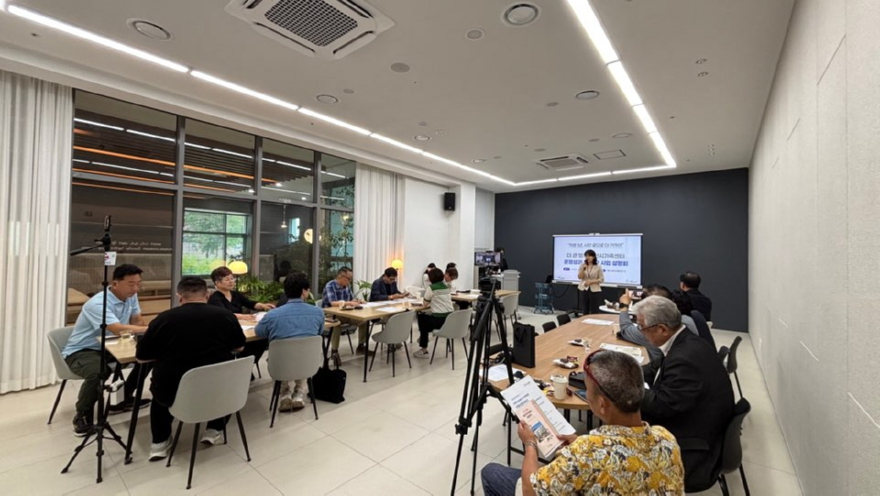
Marking the first anniversary of direct municipal management at the Pocheon Family Center, the city aligns grassroots social welfare with its structural population strategies to combat demographic decline.
Declining birth rates, an aging populace, the rise of single-person households, and the shifting dynamics of multicultural families—today’s regional municipalities can no longer afford to operate under the assumption of a single, standardized family unit. The structural boundaries of domestic life have permanently fractured, and the conditions of survival have grown infinitely more complex. The defining question for local governance is no longer whether change is occurring, but whether the state's administrative apparatus possesses the agility to keep pace.
In this context, Pocheon City’s disclosure of the first-year achievements of the directly managed "Greater Happiness Pocheon Family Center" carries significance far beyond a routine bureaucratic update. It signals a deliberate policy pivot: reframing family support not as an outsourced, secondary arm of public charity, but as a core pillar of livelihood-centered welfare directly guaranteed by the local government.
On July 16, 2026, the Pocheon Family Center held a briefing for regional media under the banner "One Year of Direct Management, Closer to Citizens," outlining its operational trajectory since transitioning to a direct municipal agency in July 2025. According to the center's metrics, utilization rates have grown uniformly across its core life-cycle services, which include family counseling, parenting education, co-parenting hubs, multicultural integration support, and customized life-care programs for single-person households. On the surface, this reads as the standard stabilization of a public institution. Beneath the administrative vocabulary, however, lies a clear blueprint of how a municipal government intends to re-engineer its social fabric.
◇ The Imperative of Direct Municipal Accountability
The rising prominence of localized family centers stems from a stark reality: modern welfare demands are highly fragmented. The acute anxieties of a young couple navigating childcare are structurally distinct from the profound isolation experienced by an aging or middle-aged single resident. Similarly, the institutional barriers faced by multicultural families require an entirely different caliber of language and administrative navigation. Though grouped under the omnibus term "family," actual human needs remain deeply individualized. The modern family center must therefore transcend its legacy role as a mere vendor of public programs; it must serve as the primary civic nexus where the state diagnoses and connects disparate human conditions.
Pocheon’s strategic emphasis on its "first anniversary of direct management" (직영) addresses the core issue of institutional accountability. While the flexibility of private outsourcing has its place in public administration, foundational livelihood infrastructure requires the continuity, funding stability, and direct mandate of the local government. When operational liabilities are clear, policy execution accelerates, allowing real-time grassroots demands to translate into budgetary allocations without intermediate bureaucratic friction. For the citizen, access becomes legible: they know precisely which public door to knock on. In the architecture of social welfare, legibility is often just as critical as the service itself.
This mandate is amplified in an urban-rural complex (도농복합도시) like Pocheon. Issues such as shifting multicultural demographics, the proliferation of single-person households, childcare deficits, and the emotional isolation of the rural elderly do not exist in isolation; they compound one another. If a family center contents itself with staging performative, event-driven programming, its systemic utility evaporates. Conversely, if it meticulously maps regional vulnerabilities and tailors its initiatives to match the evolving household structures, it becomes the most pragmatic foundation for demographic resilience.
◇ Connecting Grassroots Care to Population Strategy
This operational philosophy is deeply intertwined with Pocheon’s broader institutional restructuring, most notably the recent establishment of its dedicated Population Growth Bureau. Historically, local governments have misdiagnosed depopulation as a superficial numbers game, pouring resources into short-term cash incentives for childbirth or performative campaigns to attract outsiders.
The more profound, existential queries lie elsewhere: How securely can the current inhabitants sustain their lives? Can a family raise a child without systemic anxiety? Can a solitary resident exist within a reliable web of baseline human connection? A family center operates as the front-line trench of livelihood welfare answering these exact questions. For any population retention policy to yield measurable results, it must first stabilize the micro-structures of family, care, and daily life.
Naturally, a single year of quantitative data is insufficient for a definitive policy appraisal. While rising utilization rates are an encouraging indicator, volume alone does not guarantee the qualitative depth of social care. The true benchmarks of success remain qualitative: whether participating citizens experience a measurable mitigation of household stress, whether historically disenfranchised populations are being woven into the civic matrix, and whether municipal interventions forge durable, self-sustaining community networks.
◇ The Road Ahead: Three Policy Mandates
Pocheon’s stated intent to cross-reference the family center’s internal database with the upcoming resident registration fact-finding audit (주민등록 사실조사) to unearth hidden pockets of vulnerability is a highly sophisticated administrative move. Social safety nets rarely fail due to a lack of statutory frameworks; they fail because the bureaucracy fails to locate the individual in real time. Shifting from aggregate statistical averages to the precise tracking of individual households marks a critical transition from a supplier-centric model to a resident-centered philosophy.
To cement its status as a true sanctuary of regional welfare, however, the center must navigate three distinct mandates moving forward:
First, it must aggressively lower the psychological and physical barriers to its services, recognizing that the citizens most in need of public assistance are often the most hesitant to approach a government facility.
Second, it must dissolve administrative silos, ensuring that family welfare operates in lockstep with municipal housing, public health, education, and employment departments.
Third, the city must evaluate the center’s performance through substantive quality-of-life indicators—such as domestic stability indices and the closure of childcare gaps—rather than superficial case tallies.
During the briefing, Director Kim Su-jung emphasized a vision of "a community space for family support where anyone, regardless of family structure or circumstance, can find comfort." In the modern era, any family policy that predicates its resources on a rigid definition of the "traditional family" immediately divorces itself from reality. Public welfare must cease classifying the forms of human companionship and focus entirely on diagnosing their hardships.
The first year of Pocheon’s direct management sends an unmistakable signal: the family is no longer an afterthought of municipal logistics, but the absolute center of its administrative gravity. The era of treating population policy as a mere competition of census digits is over. The future belongs to cities that systematically reduce the precarity of daily life, ensure social networks remain unbroken, and guarantee baseline care to every resident, regardless of the shape of their household. The window of the Pocheon Family Center has opened; how wide and how deeply the city chooses to expand that view will dictate the ultimate success of its regional survival strategy.
BEST 뉴스
-

경민고 총동문회 골프팀 SBS골프 고교골프최강전 4강 진출 쾌거 10월 13일 준결승 격돌
경민고 총동문회 골프팀 SBS골프 고교골프최강전 4강 진출 쾌거 10월 13일 준결승 격돌 경민고등학교 총동문회 골프팀이 SBS골프 고교골프최강전 8강전에서 승리를 거두며 당당히 4강 진출의 쾌거를 달성했다. 전국 각지의 명문 고교 동문들이 출전해 모교의 명예와 장학금을 걸고 맞붙... -

가을 정취 물들이는 허브아일랜드 관광객을 위한 음악회 성황
가을 정취 물들이는 허브아일랜드 관광객을 위한 음악회 성황 가수 김용국 김봉규 단장의 색소폰 연주 가수 화영,황용 등 다채로운 무대 선사 가을 정취를 더하는 허브아일랜드 관광객을 위한 음악회가 열려 방문객들의 큰 호응을 얻고 있다. 트리플에이픽쳐스와 허브아일랜드... -

글로벌문화교류연합회 MOU 협약식 및 임명장 수여식 국회서 17일 개최
글로벌문화교류연합회 MOU 협약식 및 임명장 수여식 국회서 17일 개최 글로벌문화교류연합회와 장경태 의원실이 공동으로 주최하는 글로벌 문화교류 및 상호협력 활성화를 위한 MOU 협약식 및 임명장 수여식이 다가오는 10월 17일 토요일 14시부터 17시까지 국회 제8간담회의실에서 성대하게 열린다. 글로벌... -

포천 허브아일랜드 핑크뮬리 축제와 야간개장으로 가을맞이 본격화
포천 허브아일랜드 핑크뮬리 축제와 야간개장으로 가을맞이 본격화 경기 포천시 대표 관광지인 허브아일랜드가 가을 시즌을 맞아 핑크뮬리 축제 개막과 함께 야간개장을 본격적으로 운영하며 방문객 맞이에 나섰다. 허브아일랜드는 지난 9월 19일부터 가을 대표 축제인 핑크뮬리 축제를 시작했다. 스카이 허... -

제16회 계룡군문화축제 10월 1일 화려한 개막
제16회 계룡군문화축제 10월 1일 화려한 개막 대한민국 대표 군문화 축제인 제16회 계룡군문화축제가 오는 10월 1일부터 5일까지 5일간 계룡대 활주로 일대에서 펼쳐진다. 10월 1일 개막식은 오후 6시 30분 미8군 군악대 등의 식전공연을 시작으로 막을 올린다. 이어 오후 7시부터는 소향과 포레스텔라의... -

도쿄 번호판 달고 DMZ까지… 일본 경형 로드스터 고성 통일전망대 주차장 포착
도쿄 번호판 달고 DMZ까지… 일본 경형 로드스터 고성 통일전망대 주차장 포착 29일 오전 강원도 고성군 통일전망대 주차장에 일본 현지 번호판을 부착한 경형 오픈카 한 대가 주차되어 있어 관광객들의 눈길을 사로잡았다. 해당 차량은 일본 다이하츠 사의 2인승 경형 하드탑 컨버터블인 '코펜 세로' 모델로...
전체댓글 0
실시간뉴스


![[헤드라인] 아시아 최초 림팩 연합사령관 임무 수행, 대한민국 해군 위상 드높인다](/data/news/202607/news_1783140948.1.jpg)

추천뉴스






의정부시
more +단체
more +-

금감원 공시 개편에 삼천당제약 ‘프로핏 쉐어’ 재평가… ‘진가’ 고개를 들다
금융감독원이 제약·바이오 기업의 공시 체계를 전면 개편하고 계약금과 마일스톤, 로열티 및 이익배분 ... -

포천 신북면 ‘포담장터’ 7월 11일 개장… 먹거리·공연·나눔밥상까지 풍성
경기 포천시 신북면에서 지역 주민과 관광객이 함께 즐길 수 있는 먹거리 장터가 열린다. 포천 신북면 ... -
![[메트로기획] 붓끝에 되살린 소동파의 철학](/data/news/202607/news_1783652004.1.jpg)
[메트로기획] 붓끝에 되살린 소동파의 철학
소동파(蘇軾)의 대표 산문 〈전적벽부(前赤壁賦)〉가 이종훈 포천문화원장의 필치로 대형 서예 작품으... -
![[메트로기획] 모수국과 무지랭이골에 대한 연구 ①](/data/news/202607/news_1783613916.1.jpg)
[메트로기획] 모수국과 무지랭이골에 대한 연구 ①
경기 의정부시 고산주민센터에서 진행하는 치매예방 프로그램 ‘웃음빵빵 두뇌짱짱’ 수업 시간이었다. ...
포토뉴스
more +-

90세 노모가 입혀준 붉은 점퍼 소통과 효심으로 그리는 포천의 미래
90세 노모가 입혀준 붉은 점퍼 소통과 효심으로 그리는 포천의 미래 정치인의 선거복은 흔히 당적을 상징하지만 백영현 포천시장 후보에게 붉은 점퍼는 그 이상의 특별한 의미를 지닌다. 최근 90세 노모가 아들에게 직접 선거 운동복을 입혀주는 모습이 포착되면서 지역 사회에 잔잔한 감동을 전하고 ... -

국민의힘, 포천 시의원 선거 ‘위기론’ 확산... 승부수는 ‘필승 전략공천’
국민의힘, 포천 시의원 선거 ‘위기론’ 확산... 승부수는 ‘필승 전략공천’ 가선거구 서과석·나선거구 안애경 전면 배치설... 박윤경 후보 비례대표 선회론도 ‘솔솔’ 오는 6월 3일 제9회 전국동시지방선거를 앞두고 포천 지역 국민의힘 진영 내에서 위기감이 고조되고 있다. 선거 판세가 안개 속으... -

임종훈 포천시의장, '험로' 무소속 시의원 3선 도전...
"포천 향한 진심으로 승부" 임종훈 포천시의회 의장이 다가오는 지방선거에서 포천시장 출마 대신 '무소속으로 시의원 3선 재도전'이라는 파격적인 행보를 결정하며 지역 정가의 이목을 집중시키고 있다.그동안 유력한 시장 후보군으로 거론되며 체급을 키워온 임 의장의 이번 결정은 정치적 영달을 위한 '높... -
가을 정취 물들이는 허브아일랜드 관광객을 위한 음악회 성황
가을 정취 물들이는 허브아일랜드 관광객을 위한 음악회 성황 가수 김용국 김봉규 단장의 색소폰 연주 가수 화영,황용 등 다채로운 무대 선사 가을 정취를 더하는 허브아일랜드 관광객을 위한 음악회가 열려 방문객들의 큰 호응을 얻고 있다. 트리플에이픽쳐스와 허브아일랜드가 주최 주관하고 포천...
