


- The Pocheon City Youth Foundation launches its 2026 international exchange with Huaibei, China, reframing short-term student travel as a strategic investment in local livability and demographic resilience.
When calculating the future viability of a regional city, policymakers routinely look to tangible infrastructure—highways, industrial complexes, and housing outlays. Yet, the long-term longevity of a community is frequently dictated by a far more intangible variable: the caliber of experience provided to its next generation. The existential question for a depopulating municipality is whether its youth feel anchored to the region, whether they are granted the structural space to imagine a broader world, and whether they can envision intertwining their personal trajectories with the future of their hometown.
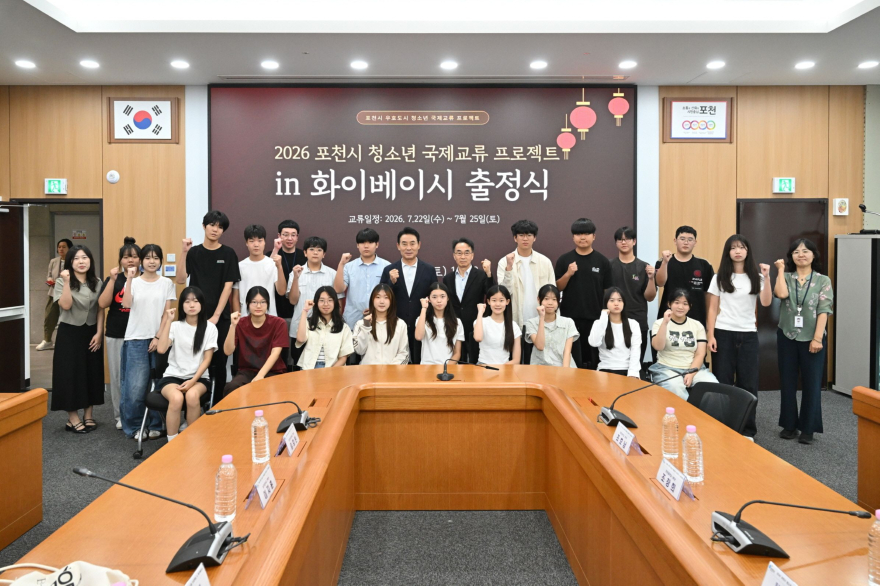
From this perspective, the official send-off ceremony held by the Pocheon City Youth Foundation on July 20 carries weight far beyond a routine student field trip. It serves as an empirical demonstration of how adolescent mobility can be leveraged as a core pillar of regional competitiveness.
The ceremony marked the prelude to the 2026 Youth International Exchange Project targeting Huaibei City in Anhui Province, China. Composed of 20 local students rigorously selected through a competitive process of open recruitment and interviews, the delegation will embark on a four-day, three-night itinerary from July 22 to 25. The cohort is scheduled to audit local schools, public institutions, and cultural and industrial facilities while engaging in collaborative summits with their Chinese peers. Superficially, it is a brief excursion. Politically and sociologically, however, a single well-curated international encounter during adolescence possesses the unique capacity to permanently alter a young citizen's cognitive horizon.
Moving Past Transactional Tourism to Cumulative Diplomacy
The true utility of international exchange does not reside in the superficial consumption of a foreign landscape. Rather, its value lies in forcing an immediate confrontation with "the world outside," a process that inevitably compels youth to re-evaluate their own communities with a critical, comparative lens.
Adolescent travel introduces structural questions that classroom instruction cannot replicate: How do other societies organize their public spaces? What drives the ambitions of my global peers? How can my hometown adapt to a globalized economy?
Furthermore, institutionalizing these initiatives under the framework of sister-city agreements introduces possibilities that conventional tourism cannot match. Instead of a series of disconnected, one-off visits, sister-city diplomacy allows for the steady accumulation of institutional trust. If Pocheon successfully regularizes these reciprocal visitations and refines its joint programming, the youth exchange can serve as a conduit for long-term bilateral integration across educational, cultural, and eventually administrative sectors.
`This strategic focus aligns seamlessly with Pocheon’s broader administrative trajectory, most notably its recent institutional focus on enhancing regional 정주 여건 (living conditions) to combat depopulation. Youth migration away from rural peripheries is rarely driven by employment deficits alone; a perceived starvation of cultural, educational, and experiential opportunities rapidly transforms a hometown into a claustrophobic space.
Conversely, demonstrating that global connectivity can be accessed directly from within the regional periphery fundamentally alters the psychological value of local residency. An exceptional living environment is defined not merely by real estate and transit links, but by whether the architecture of human growth is embedded within the city's borders.
The Prerequisites for Substantive Success
To ensure this initiative yields durable civic dividends rather than evaporating as a performative exercise, the Pocheon City Youth Foundation must navigate three distinct operational challenges:
Democratization of Access: The selection matrix must remain unflinchingly transparent, ensuring that these fully funded international opportunities do not degenerate into insular privileges for well-connected or affluent student demographics.
Knowledge Re-Integration: The return of the delegation must not terminate with the submission of a dry bureaucratic report. The city must engineer public forums where participating youth can actively share their global insights with the broader community and anchor mentorship pipelines for their peers.
Qualitative Auditing: The municipal apparatus must move past superficial satisfaction surveys, evaluating the project instead through sophisticated longitudinal indicators—tracking changes in the participants' career trajectories, global cultural literacy, and long-term civic attachment to Pocheon.
Some regional development experts have hinted that these educational exchanges could eventually pave the way for real-world economic cooperation, particularly in local manufacturing and agricultural technology transfer. However, immediate caution is warranted: youth diplomacy must never be prematurely hollowed out or transactionalized for commercial utility. The primary mandate of the project must remain the unvarnished intellectual and social expansion of the next generation. The industrial assets and cross-border networks will materialize naturally as a secondary byproduct of accumulated human capital.
As the Pocheon City Youth Foundation moves to regularize its exchange pipelines with Huaibei, the final benchmark of success will be dictated by programmatic density rather than historical inertia. Regional youth policy must permanently transition from a defensive posture of protection to an active architecture of opportunity. Ironically, the most effective method for inspiring young citizens to anchor their futures at home is to confidently grant them the keys to explore the world outside. The true verdict on Pocheon’s 2026 project will be delivered not when the delegation boards the plane to China, but in how profoundly the experience expands the civic imagination of the city they return to.
BEST 뉴스
-

경민고 총동문회 골프팀 SBS골프 고교골프최강전 4강 진출 쾌거 10월 13일 준결승 격돌
경민고 총동문회 골프팀 SBS골프 고교골프최강전 4강 진출 쾌거 10월 13일 준결승 격돌 경민고등학교 총동문회 골프팀이 SBS골프 고교골프최강전 8강전에서 승리를 거두며 당당히 4강 진출의 쾌거를 달성했다. 전국 각지의 명문 고교 동문들이 출전해 모교의 명예와 장학금을 걸고 맞붙... -

가을 정취 물들이는 허브아일랜드 관광객을 위한 음악회 성황
가을 정취 물들이는 허브아일랜드 관광객을 위한 음악회 성황 가수 김용국 김봉규 단장의 색소폰 연주 가수 화영,황용 등 다채로운 무대 선사 가을 정취를 더하는 허브아일랜드 관광객을 위한 음악회가 열려 방문객들의 큰 호응을 얻고 있다. 트리플에이픽쳐스와 허브아일랜드... -

글로벌문화교류연합회 MOU 협약식 및 임명장 수여식 국회서 17일 개최
글로벌문화교류연합회 MOU 협약식 및 임명장 수여식 국회서 17일 개최 글로벌문화교류연합회와 장경태 의원실이 공동으로 주최하는 글로벌 문화교류 및 상호협력 활성화를 위한 MOU 협약식 및 임명장 수여식이 다가오는 10월 17일 토요일 14시부터 17시까지 국회 제8간담회의실에서 성대하게 열린다. 글로벌... -

포천 허브아일랜드 핑크뮬리 축제와 야간개장으로 가을맞이 본격화
포천 허브아일랜드 핑크뮬리 축제와 야간개장으로 가을맞이 본격화 경기 포천시 대표 관광지인 허브아일랜드가 가을 시즌을 맞아 핑크뮬리 축제 개막과 함께 야간개장을 본격적으로 운영하며 방문객 맞이에 나섰다. 허브아일랜드는 지난 9월 19일부터 가을 대표 축제인 핑크뮬리 축제를 시작했다. 스카이 허... -

도쿄 번호판 달고 DMZ까지… 일본 경형 로드스터 고성 통일전망대 주차장 포착
도쿄 번호판 달고 DMZ까지… 일본 경형 로드스터 고성 통일전망대 주차장 포착 29일 오전 강원도 고성군 통일전망대 주차장에 일본 현지 번호판을 부착한 경형 오픈카 한 대가 주차되어 있어 관광객들의 눈길을 사로잡았다. 해당 차량은 일본 다이하츠 사의 2인승 경형 하드탑 컨버터블인 '코펜 세로' 모델로... -

제16회 계룡군문화축제 10월 1일 화려한 개막
제16회 계룡군문화축제 10월 1일 화려한 개막 대한민국 대표 군문화 축제인 제16회 계룡군문화축제가 오는 10월 1일부터 5일까지 5일간 계룡대 활주로 일대에서 펼쳐진다. 10월 1일 개막식은 오후 6시 30분 미8군 군악대 등의 식전공연을 시작으로 막을 올린다. 이어 오후 7시부터는 소향과 포레스텔라의...
전체댓글 0
실시간뉴스


![[헤드라인] 아시아 최초 림팩 연합사령관 임무 수행, 대한민국 해군 위상 드높인다](/data/news/202607/news_1783140948.1.jpg)

추천뉴스






의정부시
more +단체
more +-

금감원 공시 개편에 삼천당제약 ‘프로핏 쉐어’ 재평가… ‘진가’ 고개를 들다
금융감독원이 제약·바이오 기업의 공시 체계를 전면 개편하고 계약금과 마일스톤, 로열티 및 이익배분 ... -

포천 신북면 ‘포담장터’ 7월 11일 개장… 먹거리·공연·나눔밥상까지 풍성
경기 포천시 신북면에서 지역 주민과 관광객이 함께 즐길 수 있는 먹거리 장터가 열린다. 포천 신북면 ... -
![[메트로기획] 붓끝에 되살린 소동파의 철학](/data/news/202607/news_1783652004.1.jpg)
[메트로기획] 붓끝에 되살린 소동파의 철학
소동파(蘇軾)의 대표 산문 〈전적벽부(前赤壁賦)〉가 이종훈 포천문화원장의 필치로 대형 서예 작품으... -
![[메트로기획] 모수국과 무지랭이골에 대한 연구 ①](/data/news/202607/news_1783613916.1.jpg)
[메트로기획] 모수국과 무지랭이골에 대한 연구 ①
경기 의정부시 고산주민센터에서 진행하는 치매예방 프로그램 ‘웃음빵빵 두뇌짱짱’ 수업 시간이었다. ...
포토뉴스
more +-

90세 노모가 입혀준 붉은 점퍼 소통과 효심으로 그리는 포천의 미래
90세 노모가 입혀준 붉은 점퍼 소통과 효심으로 그리는 포천의 미래 정치인의 선거복은 흔히 당적을 상징하지만 백영현 포천시장 후보에게 붉은 점퍼는 그 이상의 특별한 의미를 지닌다. 최근 90세 노모가 아들에게 직접 선거 운동복을 입혀주는 모습이 포착되면서 지역 사회에 잔잔한 감동을 전하고 ... -

국민의힘, 포천 시의원 선거 ‘위기론’ 확산... 승부수는 ‘필승 전략공천’
국민의힘, 포천 시의원 선거 ‘위기론’ 확산... 승부수는 ‘필승 전략공천’ 가선거구 서과석·나선거구 안애경 전면 배치설... 박윤경 후보 비례대표 선회론도 ‘솔솔’ 오는 6월 3일 제9회 전국동시지방선거를 앞두고 포천 지역 국민의힘 진영 내에서 위기감이 고조되고 있다. 선거 판세가 안개 속으... -

임종훈 포천시의장, '험로' 무소속 시의원 3선 도전...
"포천 향한 진심으로 승부" 임종훈 포천시의회 의장이 다가오는 지방선거에서 포천시장 출마 대신 '무소속으로 시의원 3선 재도전'이라는 파격적인 행보를 결정하며 지역 정가의 이목을 집중시키고 있다.그동안 유력한 시장 후보군으로 거론되며 체급을 키워온 임 의장의 이번 결정은 정치적 영달을 위한 '높... -
가을 정취 물들이는 허브아일랜드 관광객을 위한 음악회 성황
가을 정취 물들이는 허브아일랜드 관광객을 위한 음악회 성황 가수 김용국 김봉규 단장의 색소폰 연주 가수 화영,황용 등 다채로운 무대 선사 가을 정취를 더하는 허브아일랜드 관광객을 위한 음악회가 열려 방문객들의 큰 호응을 얻고 있다. 트리플에이픽쳐스와 허브아일랜드가 주최 주관하고 포천...
