


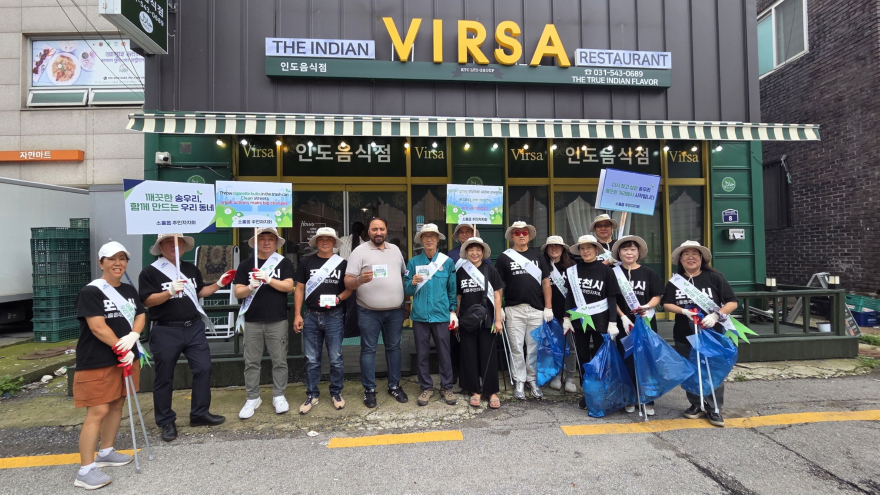
By establishing a recurring sanitation drive along Solmoru International Street, a Pocheon municipality shifts away from performative public acts to build an integrated governance model for native merchants and immigrant workers.
A city’s competitive edge is rarely derived from sprawling development blueprints alone. Instead, a municipality’s lasting impression is forged in the mundane geography of daily life—the streets citizens walk every day, the visual rhythm of commercial districts where they shop and dine, and an open environment where even strangers can linger without hesitation. In areas characterized by high pedestrian traffic and highly diverse demographics, street cleanliness and order are not mere cosmetic concerns; they serve as a profound index of a community's mutual trust and structural inclusivity. Therefore, the recent environmental initiative launched by the Sohul-eup Resident Autonomy Committee along "Solmoru International Street" carries significance far beyond a routine sanitation drive. To remediate a streetscape is, ultimately, to declare what kind of community a locality aspires to become.
On July 18, 2026, the Sohul-eup Resident Autonomy Committee initiated its first campaign under the banner, "Clean Songou-ri, Building an International Street Together," targeting the Solmoru corridor and the central commercial district of Songou-ri. Scheduled as a recurring monthly operation running through October, the project moves away from the performative nature of one-off bureaucratic exercises. During this inaugural phase, committee members and local civil servants from the Sohul-eup Administrative Welfare Center canvassed local businesses, distributing "Clean Store" seals and engaging merchants on the shared necessity of urban upkeep. The true value of this modest intervention lies not in the physical act of sweeping, but in its structural shift: transferring the burden of public maintenance away from the state alone and transforming it into a joint liability shared by residents and shopkeepers alike.
◇ Remediating the Shared Commons
Crucially, the campaign places the distinct spatial identity of an "International Street" at the center of its framework. The Songou-ri enclave serves as a dense commercial and residential hub within Pocheon, functioning as a primary cultural intersection for migrant workers and immigrants. In such highly integrated spaces, the condition of the streetscape transcends simple sanitation metrics; it is deeply intertwined with how populations carrying disparate languages, cultures, and domestic habits negotiate shared spaces. Consequently, remediating the international district is simultaneously an exercise in physical engineering and social calibration. It bypasses divisive questions of territorial ownership to confront a more vital democratic query: how can diverse groups co-author the codes of a shared civic commons?
This structural reality underscores the committee's forward-looking blueprint to progressively expand the active participation of migrant workers and immigrant advocacy groups. Urban remediation within multicultural enclaves rarely achieves durability when practicing a paternalistic model of native residents correcting the behavior of foreign "subjects." Authentic transformation materializes only when every demographic inhabiting a space is granted full agency within it. If migrant workers anchor a substantial segment of the regional economy, they must be recognized as primary stakeholders in shaping local street culture. Coexistence cannot be secured by the passive vocabulary of tolerance alone; it demands a shared seat at the table of civic execution. If the title "International Street" is to transcend empty municipal rhetoric, the right—and the responsibility—to design its order and aesthetics must be democratically decentralized.
◇ Aligning Local Sanitation with Demographic Strategy
This localized campaign aligns seamlessly with Pocheon City's broader macro-strategies, particularly its focus on shifting demographics and upgrading regional living conditions. As the twin headwinds of a declining birth rate and a rapidly aging native populace intersect with a rising immigrant demographic, regional municipalities must pivot their focus from aggregate census tallies to social cohesion—asking not merely how many live within their borders, but how harmoniously disparate groups can coexist. True livability cannot be generated solely through real estate outlays or highway expansions. It relies on granular variables: the perceived safety of a corridor, the economic vitality of a commercial district, and the systemic insulation of foreign residents from civic marginalization. In this respect, Sohul-eup’s international corridor acts as a vital laboratory where Pocheon’s demographic future is actively being written.
Naturally, romanticizing a cleanliness drive would be an analytical error; a pristine sidewalk does not automatically trigger commercial revitalization or seamless social integration. The survival of a business district relies on navigating dense structural headwinds: commercial rent pressures, broader consumer stagnation, pedestrian and parking infrastructure, systemic waste management failures, and nocturnal safety architectures. Furthermore, declaring an intent to expand immigrant inclusion is toothless without rigorous operational scaffolding. Local authorities must answer precise logistical queries: how to systematically dissolve language barriers, who will engineer the mechanisms of public participation, and which institutional entities will mediate potential friction between merchants, native residents, and migrant workers. Civic governance requires structural precision, not merely noble intentions.
◇ Cultivating the Discipline of Governance
Nevertheless, the endeavor deserves serious defense because meaningful regional transformation is almost universally born from these small, iterative practices. The critical asset is not a singular massive sweep, but rather sharing a collective inquiry within the neighborhood: how do we permanently steward this space? In this sense, regularizing the drive into a fixed monthly calendar is deeply symbolic. A streetscape cannot be permanently resolved by a one-time deployment of resources, and neither can a community; both require constant cultivation, persistent dialogue, and synchronized motion.
The placement of the "Clean Store" seals carries genuine administrative weight. It functions as a micro-contract, affirming that individual merchants are primary authors of public space. Civic consciousness is not born from abstract moral lectures; it is made manifest in how a person manages the few meters of pavement directly outside their shop window or doorstep. Viewed through this lens, the observation by Kim Sang-hyuk, president of the Resident Autonomy Committee, that "small practices lay the foundations for mature citizenship," addresses the absolute core of regional governance.
This sentiment is closely echoed by Sohul-eup Director Yu Jae-hyun’s emphasis on transforming Songou-ri into a destination where travelers genuinely wish to linger. The competitive edge of a modern commercial zone can no longer rely on the transactional sale of goods alone. It requires a curated environment, a memorable physical footprint, and a palpable sense that diverse populations can inhabit a territory safely together.
Ultimately, the remediation of Solmoru International Street is an exercise in clearing litter and recalibrating human relationships simultaneously. Rather than offloading systemic blame onto a marginalized demographic, it represents an ongoing effort by residents, merchants, civil servants, and migrant workers to co-author the standards of their shared environment. For Pocheon to transform this campaign into a durable structural asset, the operation must leave behind a lasting legacy of civic protocols and institutionalized inclusive culture long after the final scheduled drive in October. When a streetscape changes, the behavior of its inhabitants inevitably adapts—and when human behavior transforms, the very face of the community is permanently remade.
BEST 뉴스
-

경민고 총동문회 골프팀 SBS골프 고교골프최강전 4강 진출 쾌거 10월 13일 준결승 격돌
경민고 총동문회 골프팀 SBS골프 고교골프최강전 4강 진출 쾌거 10월 13일 준결승 격돌 경민고등학교 총동문회 골프팀이 SBS골프 고교골프최강전 8강전에서 승리를 거두며 당당히 4강 진출의 쾌거를 달성했다. 전국 각지의 명문 고교 동문들이 출전해 모교의 명예와 장학금을 걸고 맞붙... -

가을 정취 물들이는 허브아일랜드 관광객을 위한 음악회 성황
가을 정취 물들이는 허브아일랜드 관광객을 위한 음악회 성황 가수 김용국 김봉규 단장의 색소폰 연주 가수 화영,황용 등 다채로운 무대 선사 가을 정취를 더하는 허브아일랜드 관광객을 위한 음악회가 열려 방문객들의 큰 호응을 얻고 있다. 트리플에이픽쳐스와 허브아일랜드... -

글로벌문화교류연합회 MOU 협약식 및 임명장 수여식 국회서 17일 개최
글로벌문화교류연합회 MOU 협약식 및 임명장 수여식 국회서 17일 개최 글로벌문화교류연합회와 장경태 의원실이 공동으로 주최하는 글로벌 문화교류 및 상호협력 활성화를 위한 MOU 협약식 및 임명장 수여식이 다가오는 10월 17일 토요일 14시부터 17시까지 국회 제8간담회의실에서 성대하게 열린다. 글로벌... -

포천 허브아일랜드 핑크뮬리 축제와 야간개장으로 가을맞이 본격화
포천 허브아일랜드 핑크뮬리 축제와 야간개장으로 가을맞이 본격화 경기 포천시 대표 관광지인 허브아일랜드가 가을 시즌을 맞아 핑크뮬리 축제 개막과 함께 야간개장을 본격적으로 운영하며 방문객 맞이에 나섰다. 허브아일랜드는 지난 9월 19일부터 가을 대표 축제인 핑크뮬리 축제를 시작했다. 스카이 허... -

제16회 계룡군문화축제 10월 1일 화려한 개막
제16회 계룡군문화축제 10월 1일 화려한 개막 대한민국 대표 군문화 축제인 제16회 계룡군문화축제가 오는 10월 1일부터 5일까지 5일간 계룡대 활주로 일대에서 펼쳐진다. 10월 1일 개막식은 오후 6시 30분 미8군 군악대 등의 식전공연을 시작으로 막을 올린다. 이어 오후 7시부터는 소향과 포레스텔라의... -

도쿄 번호판 달고 DMZ까지… 일본 경형 로드스터 고성 통일전망대 주차장 포착
도쿄 번호판 달고 DMZ까지… 일본 경형 로드스터 고성 통일전망대 주차장 포착 29일 오전 강원도 고성군 통일전망대 주차장에 일본 현지 번호판을 부착한 경형 오픈카 한 대가 주차되어 있어 관광객들의 눈길을 사로잡았다. 해당 차량은 일본 다이하츠 사의 2인승 경형 하드탑 컨버터블인 '코펜 세로' 모델로...
전체댓글 0
실시간뉴스


![[헤드라인] 아시아 최초 림팩 연합사령관 임무 수행, 대한민국 해군 위상 드높인다](/data/news/202607/news_1783140948.1.jpg)

추천뉴스






의정부시
more +단체
more +-

금감원 공시 개편에 삼천당제약 ‘프로핏 쉐어’ 재평가… ‘진가’ 고개를 들다
금융감독원이 제약·바이오 기업의 공시 체계를 전면 개편하고 계약금과 마일스톤, 로열티 및 이익배분 ... -

포천 신북면 ‘포담장터’ 7월 11일 개장… 먹거리·공연·나눔밥상까지 풍성
경기 포천시 신북면에서 지역 주민과 관광객이 함께 즐길 수 있는 먹거리 장터가 열린다. 포천 신북면 ... -
![[메트로기획] 붓끝에 되살린 소동파의 철학](/data/news/202607/news_1783652004.1.jpg)
[메트로기획] 붓끝에 되살린 소동파의 철학
소동파(蘇軾)의 대표 산문 〈전적벽부(前赤壁賦)〉가 이종훈 포천문화원장의 필치로 대형 서예 작품으... -
![[메트로기획] 모수국과 무지랭이골에 대한 연구 ①](/data/news/202607/news_1783613916.1.jpg)
[메트로기획] 모수국과 무지랭이골에 대한 연구 ①
경기 의정부시 고산주민센터에서 진행하는 치매예방 프로그램 ‘웃음빵빵 두뇌짱짱’ 수업 시간이었다. ...
포토뉴스
more +-

90세 노모가 입혀준 붉은 점퍼 소통과 효심으로 그리는 포천의 미래
90세 노모가 입혀준 붉은 점퍼 소통과 효심으로 그리는 포천의 미래 정치인의 선거복은 흔히 당적을 상징하지만 백영현 포천시장 후보에게 붉은 점퍼는 그 이상의 특별한 의미를 지닌다. 최근 90세 노모가 아들에게 직접 선거 운동복을 입혀주는 모습이 포착되면서 지역 사회에 잔잔한 감동을 전하고 ... -

국민의힘, 포천 시의원 선거 ‘위기론’ 확산... 승부수는 ‘필승 전략공천’
국민의힘, 포천 시의원 선거 ‘위기론’ 확산... 승부수는 ‘필승 전략공천’ 가선거구 서과석·나선거구 안애경 전면 배치설... 박윤경 후보 비례대표 선회론도 ‘솔솔’ 오는 6월 3일 제9회 전국동시지방선거를 앞두고 포천 지역 국민의힘 진영 내에서 위기감이 고조되고 있다. 선거 판세가 안개 속으... -

임종훈 포천시의장, '험로' 무소속 시의원 3선 도전...
"포천 향한 진심으로 승부" 임종훈 포천시의회 의장이 다가오는 지방선거에서 포천시장 출마 대신 '무소속으로 시의원 3선 재도전'이라는 파격적인 행보를 결정하며 지역 정가의 이목을 집중시키고 있다.그동안 유력한 시장 후보군으로 거론되며 체급을 키워온 임 의장의 이번 결정은 정치적 영달을 위한 '높... -
가을 정취 물들이는 허브아일랜드 관광객을 위한 음악회 성황
가을 정취 물들이는 허브아일랜드 관광객을 위한 음악회 성황 가수 김용국 김봉규 단장의 색소폰 연주 가수 화영,황용 등 다채로운 무대 선사 가을 정취를 더하는 허브아일랜드 관광객을 위한 음악회가 열려 방문객들의 큰 호응을 얻고 있다. 트리플에이픽쳐스와 허브아일랜드가 주최 주관하고 포천...
