


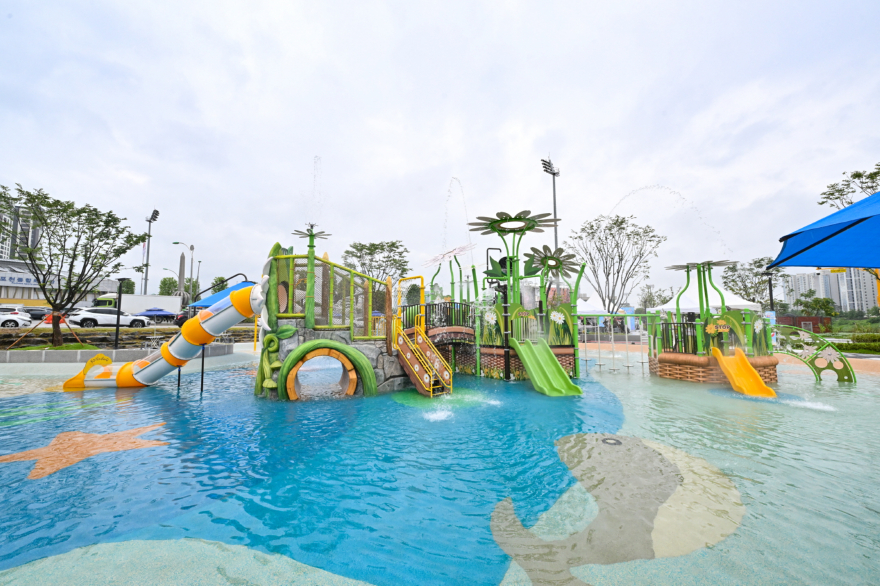
Pocheon’s new municipal water park demonstrates that regional competitiveness and residential satisfaction stem from accessible, climate-adaptive public care rather than grand infrastructure alone.
A city’s true competitiveness is rarely dictated by sprawling development blueprints or striking architectural landmarks alone. Instead, everyday livability hinges on far more intimate variables: where parents can safely take their children to play, whether families can access cost-free recreational spaces, and if residents can find respite within their own neighborhoods during severe heatwaves. In this context, Pocheon City’s official opening of a municipal children's water park near the Pocheon Sports Complex carries structural significance beyond a routine seasonal amenity. Constructing a public splash pad represents a fundamental administrative posture—a declaration of how precisely a municipality attends to the daily welfare of its citizens.
On July 20, Pocheon City formally inaugurated the children's water park near the Pocheon Sports Complex, entering full operational status through August 23. Free to all residents, the facility is equipped with an integrated children's play structure, shallow wading pools, and cooling mist systems. Operating daily from 12:00 PM to 6:00 PM—with Wednesdays reserved for regular maintenance and deep sanitation—the park's location near the urban core offers immediate accessibility. By bringing summer recreation directly into the neighborhood, the city effectively converts what was once an expensive, out-of-town excursion into a frictionless, localized public good.
The systemic value of such public amenities escalates dramatically in an era of accelerating climate precarity. Extreme summer heat is no longer merely an uncomfortable seasonal shift; it has evolved into an urgent public health hazard. For families navigating economic pressures, accessible public spaces to escape the heat without relying on costly commercial resorts are essential. In this light, a free municipal water park functions less as a simple entertainment venue and more as a vital piece of climate-adaptive welfare infrastructure. Broadening access to frictionless public spaces ensures that summer remains bearable for the entire community, rather than a privilege reserved for a few.
Furthermore, the park’s integration into the overarching "Pocheoncheon Blueway Project" merits strategic analysis. Waterfronts remain among the most intuitive assets for urban transformation. While many regional municipalities historically treated rivers and parks as passive aesthetic backdrops, modern urban planning demands their reinterpretation as active infrastructure that enhances daily livability. As a concrete output of the Blueway initiative, the new water park provides a preview of Pocheon's broader waterfront strategy—marking a transition from a city that merely observes its riverways to one that actively inhabits them.
This focus on micro-level infrastructure is also deeply intertwined with Pocheon’s broader demographic and retention strategies. For regional municipalities, upgrading living conditions (정주 여건) extends far beyond real estate expansion or highway construction. True residential retention is governed by daily experience: whether a city is hospitable to raising children, whether families can spend weekends locally without financial strain, and whether safe, high-quality public space exists near the urban center. Citizens do not root themselves in a community because of grand political slogans; they stay when daily life feels manageable, safe, and enjoyable. Micro-investments like a municipal water park play a quiet yet decisive role in shaping that daily reality.
Naturally, a single seasonal facility cannot resolve a region's structural demographic headwinds on its own. Public infrastructure derives its efficacy from operational continuity and comprehensive management. Beyond the initial public reception, long-term success requires relentless attention to surrounding amenities: shaded seating, sanitary restrooms, parking logistics, pedestrian safety, and trained emergency personnel. Facilities designed for children rely entirely on public trust regarding safety protocols, water quality, and hygiene. In this regard, Pocheon City's deployment of certified safety personnel alongside scheduled, rigorous water quality audits represents a baseline administrative obligation.
The opening also reflects a clear choice in administrative priorities. Municipal governments frequently default to high-visibility, capital-intensive projects. Yet, what citizens perceive on a daily basis are these localized, human-scale investments. Accessible spaces where children can play, families can rest, and public recreation carries no price tag touch daily lives directly. The dignity of a city is ultimately revealed through the lens of its youngest users; a municipality that invests thoughtfully in spaces for children is almost invariably one that cares meticulously for all generations.
Reflecting on the inauguration, Pocheon Mayor Bai Young-hyun underscored the symbolic weight of hearing "children's bright laughter filling the park." Municipal achievements are not measured solely on fiscal ledgers. Urban spaces come alive when citizens actively inhabit, enjoy, and return to them. While a municipal splash pad may not generate massive direct macroeconomic returns, its capacity to capture the "lifestyle population," retain local family spending, and inject vitality into the urban core makes it a highly rational public investment.
Moving forward, the primary mandate for Pocheon is operational continuity. The initiative must not remain a one-off seasonal feature, but rather serve as the first phase of a broader, year-round transformation of the Pocheoncheon waterfront into a multi-seasonal space for walking, culture, and recreation. Bridging the gap between citizens and their natural environment remains a core requirement for a truly livable city.
Ultimately, the opening of the Pocheon Sports Complex children's water park is more than a routine seasonal update. It offers a concrete answer to how a municipality protects its citizens during extreme weather, where it sets the standard for family-friendly urban design, and how closely it grounds its retention strategies in daily life. Sprawling development schemes may fade, but thoughtful, localized care leaves an enduring mark. While a splash pad alone cannot remake a city, it clearly reveals the spirit with which a government serves its people.
BEST 뉴스
-

경민고 총동문회 골프팀 SBS골프 고교골프최강전 4강 진출 쾌거 10월 13일 준결승 격돌
경민고 총동문회 골프팀 SBS골프 고교골프최강전 4강 진출 쾌거 10월 13일 준결승 격돌 경민고등학교 총동문회 골프팀이 SBS골프 고교골프최강전 8강전에서 승리를 거두며 당당히 4강 진출의 쾌거를 달성했다. 전국 각지의 명문 고교 동문들이 출전해 모교의 명예와 장학금을 걸고 맞붙... -

가을 정취 물들이는 허브아일랜드 관광객을 위한 음악회 성황
가을 정취 물들이는 허브아일랜드 관광객을 위한 음악회 성황 가수 김용국 김봉규 단장의 색소폰 연주 가수 화영,황용 등 다채로운 무대 선사 가을 정취를 더하는 허브아일랜드 관광객을 위한 음악회가 열려 방문객들의 큰 호응을 얻고 있다. 트리플에이픽쳐스와 허브아일랜드... -

글로벌문화교류연합회 MOU 협약식 및 임명장 수여식 국회서 17일 개최
글로벌문화교류연합회 MOU 협약식 및 임명장 수여식 국회서 17일 개최 글로벌문화교류연합회와 장경태 의원실이 공동으로 주최하는 글로벌 문화교류 및 상호협력 활성화를 위한 MOU 협약식 및 임명장 수여식이 다가오는 10월 17일 토요일 14시부터 17시까지 국회 제8간담회의실에서 성대하게 열린다. 글로벌... -

포천 허브아일랜드 핑크뮬리 축제와 야간개장으로 가을맞이 본격화
포천 허브아일랜드 핑크뮬리 축제와 야간개장으로 가을맞이 본격화 경기 포천시 대표 관광지인 허브아일랜드가 가을 시즌을 맞아 핑크뮬리 축제 개막과 함께 야간개장을 본격적으로 운영하며 방문객 맞이에 나섰다. 허브아일랜드는 지난 9월 19일부터 가을 대표 축제인 핑크뮬리 축제를 시작했다. 스카이 허... -

도쿄 번호판 달고 DMZ까지… 일본 경형 로드스터 고성 통일전망대 주차장 포착
도쿄 번호판 달고 DMZ까지… 일본 경형 로드스터 고성 통일전망대 주차장 포착 29일 오전 강원도 고성군 통일전망대 주차장에 일본 현지 번호판을 부착한 경형 오픈카 한 대가 주차되어 있어 관광객들의 눈길을 사로잡았다. 해당 차량은 일본 다이하츠 사의 2인승 경형 하드탑 컨버터블인 '코펜 세로' 모델로... -

제16회 계룡군문화축제 10월 1일 화려한 개막
제16회 계룡군문화축제 10월 1일 화려한 개막 대한민국 대표 군문화 축제인 제16회 계룡군문화축제가 오는 10월 1일부터 5일까지 5일간 계룡대 활주로 일대에서 펼쳐진다. 10월 1일 개막식은 오후 6시 30분 미8군 군악대 등의 식전공연을 시작으로 막을 올린다. 이어 오후 7시부터는 소향과 포레스텔라의...
전체댓글 0
실시간뉴스


![[헤드라인] 아시아 최초 림팩 연합사령관 임무 수행, 대한민국 해군 위상 드높인다](/data/news/202607/news_1783140948.1.jpg)

추천뉴스






의정부시
more +단체
more +-

금감원 공시 개편에 삼천당제약 ‘프로핏 쉐어’ 재평가… ‘진가’ 고개를 들다
금융감독원이 제약·바이오 기업의 공시 체계를 전면 개편하고 계약금과 마일스톤, 로열티 및 이익배분 ... -

포천 신북면 ‘포담장터’ 7월 11일 개장… 먹거리·공연·나눔밥상까지 풍성
경기 포천시 신북면에서 지역 주민과 관광객이 함께 즐길 수 있는 먹거리 장터가 열린다. 포천 신북면 ... -
![[메트로기획] 붓끝에 되살린 소동파의 철학](/data/news/202607/news_1783652004.1.jpg)
[메트로기획] 붓끝에 되살린 소동파의 철학
소동파(蘇軾)의 대표 산문 〈전적벽부(前赤壁賦)〉가 이종훈 포천문화원장의 필치로 대형 서예 작품으... -
![[메트로기획] 모수국과 무지랭이골에 대한 연구 ①](/data/news/202607/news_1783613916.1.jpg)
[메트로기획] 모수국과 무지랭이골에 대한 연구 ①
경기 의정부시 고산주민센터에서 진행하는 치매예방 프로그램 ‘웃음빵빵 두뇌짱짱’ 수업 시간이었다. ...
포토뉴스
more +-

90세 노모가 입혀준 붉은 점퍼 소통과 효심으로 그리는 포천의 미래
90세 노모가 입혀준 붉은 점퍼 소통과 효심으로 그리는 포천의 미래 정치인의 선거복은 흔히 당적을 상징하지만 백영현 포천시장 후보에게 붉은 점퍼는 그 이상의 특별한 의미를 지닌다. 최근 90세 노모가 아들에게 직접 선거 운동복을 입혀주는 모습이 포착되면서 지역 사회에 잔잔한 감동을 전하고 ... -

국민의힘, 포천 시의원 선거 ‘위기론’ 확산... 승부수는 ‘필승 전략공천’
국민의힘, 포천 시의원 선거 ‘위기론’ 확산... 승부수는 ‘필승 전략공천’ 가선거구 서과석·나선거구 안애경 전면 배치설... 박윤경 후보 비례대표 선회론도 ‘솔솔’ 오는 6월 3일 제9회 전국동시지방선거를 앞두고 포천 지역 국민의힘 진영 내에서 위기감이 고조되고 있다. 선거 판세가 안개 속으... -

임종훈 포천시의장, '험로' 무소속 시의원 3선 도전...
"포천 향한 진심으로 승부" 임종훈 포천시의회 의장이 다가오는 지방선거에서 포천시장 출마 대신 '무소속으로 시의원 3선 재도전'이라는 파격적인 행보를 결정하며 지역 정가의 이목을 집중시키고 있다.그동안 유력한 시장 후보군으로 거론되며 체급을 키워온 임 의장의 이번 결정은 정치적 영달을 위한 '높... -
가을 정취 물들이는 허브아일랜드 관광객을 위한 음악회 성황
가을 정취 물들이는 허브아일랜드 관광객을 위한 음악회 성황 가수 김용국 김봉규 단장의 색소폰 연주 가수 화영,황용 등 다채로운 무대 선사 가을 정취를 더하는 허브아일랜드 관광객을 위한 음악회가 열려 방문객들의 큰 호응을 얻고 있다. 트리플에이픽쳐스와 허브아일랜드가 주최 주관하고 포천...
