


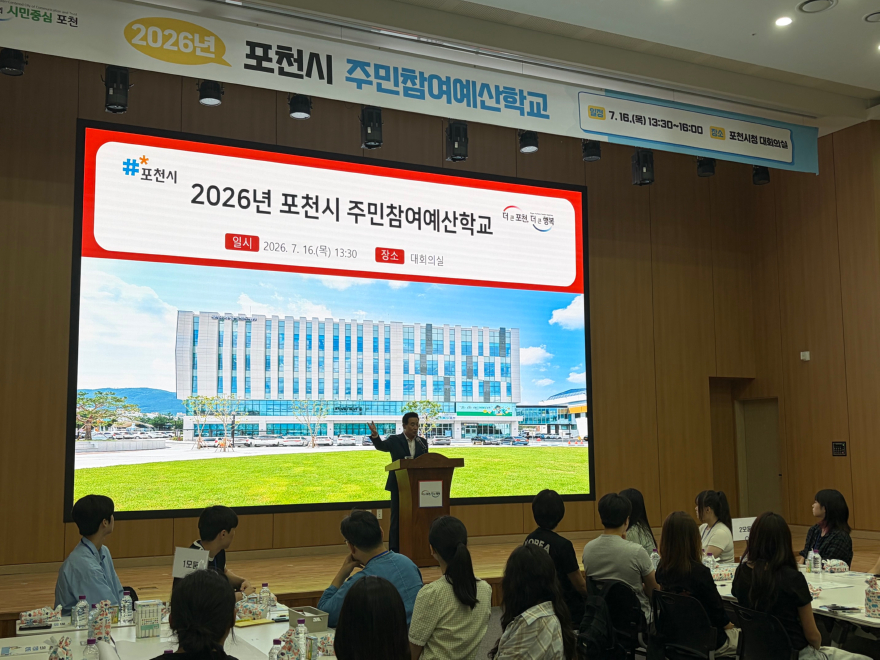
Pocheon’s participatory budgeting experiment shows that if local governments want young people to stay, they must treat them as co-architects of civic life, not passive beneficiaries.
For years, "youth policy" in municipal governance has suffered from a fundamental contradiction. Politicians routinely champion programs designed for young people, yet rarely allow them to directly design or decide those policies. Youth are summoned into the public square as objects of concern or recipients of welfare, but when it comes to translating their needs into the cold, hard mechanics of fiscal allocation, they are quietly ushered out of the room.
If local governments genuinely wish to address youth flight and revitalize declining regions, this paternalistic dynamic must end.
Pocheon City’s recent launch of its Youth Participatory Budgeting School—organized ahead of its 2027 main budget formulation—offers a compelling blueprint for how to bridge this gap. By bringing young residents together for fiscal literacy training and small-group deliberations, the city is teaching them how to translate daily friction points into concrete, actionable budget proposals.
It is a modest program on the surface, but its underlying philosophy represents a profound shift: moving youth from the periphery of policy consultation directly into the engine room of municipal finance.
◇ The Acid Test of Municipal Intent
A budget is the most honest document a government produces. It is where abstract political promises collide with scarcity, forcing leaders to reveal who they truly value and what problems they are actually willing to solve. Anyone can host a town hall or issue a press release; allocating municipal capital requires hard choices.
This is precisely why inviting young people into the budgetary process carries such symbolic and practical weight. It elevates youth policy from a promotional slogan to a structural question of resource distribution. When young residents learn how to navigate municipal accounting, draft line-item proposals, and debate priority rankings, democracy ceases to be a spectator sport.
◇ The Granular Friction of Everyday Life
This shift is particularly urgent in urban-rural regions like Pocheon, where youth retention has become an existential challenge.
Young people do not abandon small towns solely because of grand macro-economic forces; they leave because of the accumulated friction of daily life. The calculus of departure is woven from granular grievances:
Inconvenient public transit schedules for late-night commutes;
The crushing weight of housing deposits;
A dearth of "third spaces" to socialize and build community;
Fragmented access to career development information.
To an outsider or a senior city official, a missing evening bus route or a lack of affordable study cafes might seem trivial. To a 24-year-old trying to build a life in their hometown, it is often the deciding factor in packing a suitcase for Seoul.
Participatory budgeting provides a formal channel to surface these hyper-local grievances and convert them into targeted public investments.
◇ From Guests to Co-Architects
Allowing youth to participate in budget design does far more than yield better-targeted projects; it transforms their fundamental relationship with the city.
A resident’s decision to plant roots in a community is rarely based on financial calculations alone. It hinges on a sense of civic dignity—the belief that the city understands your struggles, values your voice, and treats you as a stakeholder with a vested interest in its collective future.
When a municipality treats its young residents as co-architects rather than transient guests, it fosters a deep sense of place-based belonging.
"You cannot ask young people to care about the future of a city if you refuse to give them a stake in its present."
◇ The Danger of Performative Listening
Naturally, a budgeting workshop alone does not guarantee systemic reform. The true test of Pocheon’s initiative lies in what happens after the flipcharts are put away and the proposals are submitted.
Young people today are deeply familiar with surveys, advisory panels, and public hearings. Over time, however, repeated exposure to empty consultation breeds an acute civic cynicism. If proposals are routinely shelved without clear explanations, or if the process is reduced to a rubber-stamp exercise, trust in local institutions collapses rapidly.
For Pocheon’s experiment to succeed, the city must maintain uncompromising transparency:
1. Clear Selection Criteria: Every youth-submitted project must be reviewed through a transparent framework, with detailed feedback provided for why proposals were accepted or declined.
2. Binding Integration: Accepted proposals must be meaningfully reflected in the 2027 main budget draft, rather than relegated to token ceremonial accounts.
3. Lowering the Barrier to Entry: Future iterations of the budget school must actively recruit beyond the usual cohort of hyper-engaged youth, ensuring that marginalized, working-class, and rural voices are equally represented.
◇ A Reimagined Civic Contract
Pocheon’s commitment to review youth proposals and submit them to the Municipal Participatory Budgeting Committee for the 2027 fiscal year is a promising step forward. If executed with integrity, it can demonstrate that civic participation is not merely an educational simulation, but an enforceable right.
Local governments cannot meaningfully speak about the future of their communities while leaving the current reality of their youth unfunded. When the lived experiences of young citizens are translated into real numbers and official line items, local democracy becomes far more than an abstract ideal—it becomes a living, protective force that keeps a city alive.
BEST 뉴스
-

경민고 총동문회 골프팀 SBS골프 고교골프최강전 4강 진출 쾌거 10월 13일 준결승 격돌
경민고 총동문회 골프팀 SBS골프 고교골프최강전 4강 진출 쾌거 10월 13일 준결승 격돌 경민고등학교 총동문회 골프팀이 SBS골프 고교골프최강전 8강전에서 승리를 거두며 당당히 4강 진출의 쾌거를 달성했다. 전국 각지의 명문 고교 동문들이 출전해 모교의 명예와 장학금을 걸고 맞붙... -

가을 정취 물들이는 허브아일랜드 관광객을 위한 음악회 성황
가을 정취 물들이는 허브아일랜드 관광객을 위한 음악회 성황 가수 김용국 김봉규 단장의 색소폰 연주 가수 화영,황용 등 다채로운 무대 선사 가을 정취를 더하는 허브아일랜드 관광객을 위한 음악회가 열려 방문객들의 큰 호응을 얻고 있다. 트리플에이픽쳐스와 허브아일랜드... -

글로벌문화교류연합회 MOU 협약식 및 임명장 수여식 국회서 17일 개최
글로벌문화교류연합회 MOU 협약식 및 임명장 수여식 국회서 17일 개최 글로벌문화교류연합회와 장경태 의원실이 공동으로 주최하는 글로벌 문화교류 및 상호협력 활성화를 위한 MOU 협약식 및 임명장 수여식이 다가오는 10월 17일 토요일 14시부터 17시까지 국회 제8간담회의실에서 성대하게 열린다. 글로벌... -

포천 허브아일랜드 핑크뮬리 축제와 야간개장으로 가을맞이 본격화
포천 허브아일랜드 핑크뮬리 축제와 야간개장으로 가을맞이 본격화 경기 포천시 대표 관광지인 허브아일랜드가 가을 시즌을 맞아 핑크뮬리 축제 개막과 함께 야간개장을 본격적으로 운영하며 방문객 맞이에 나섰다. 허브아일랜드는 지난 9월 19일부터 가을 대표 축제인 핑크뮬리 축제를 시작했다. 스카이 허... -

제16회 계룡군문화축제 10월 1일 화려한 개막
제16회 계룡군문화축제 10월 1일 화려한 개막 대한민국 대표 군문화 축제인 제16회 계룡군문화축제가 오는 10월 1일부터 5일까지 5일간 계룡대 활주로 일대에서 펼쳐진다. 10월 1일 개막식은 오후 6시 30분 미8군 군악대 등의 식전공연을 시작으로 막을 올린다. 이어 오후 7시부터는 소향과 포레스텔라의... -

도쿄 번호판 달고 DMZ까지… 일본 경형 로드스터 고성 통일전망대 주차장 포착
도쿄 번호판 달고 DMZ까지… 일본 경형 로드스터 고성 통일전망대 주차장 포착 29일 오전 강원도 고성군 통일전망대 주차장에 일본 현지 번호판을 부착한 경형 오픈카 한 대가 주차되어 있어 관광객들의 눈길을 사로잡았다. 해당 차량은 일본 다이하츠 사의 2인승 경형 하드탑 컨버터블인 '코펜 세로' 모델로...
전체댓글 0
실시간뉴스


![[헤드라인] 아시아 최초 림팩 연합사령관 임무 수행, 대한민국 해군 위상 드높인다](/data/news/202607/news_1783140948.1.jpg)

추천뉴스






의정부시
more +단체
more +-

금감원 공시 개편에 삼천당제약 ‘프로핏 쉐어’ 재평가… ‘진가’ 고개를 들다
금융감독원이 제약·바이오 기업의 공시 체계를 전면 개편하고 계약금과 마일스톤, 로열티 및 이익배분 ... -

포천 신북면 ‘포담장터’ 7월 11일 개장… 먹거리·공연·나눔밥상까지 풍성
경기 포천시 신북면에서 지역 주민과 관광객이 함께 즐길 수 있는 먹거리 장터가 열린다. 포천 신북면 ... -
![[메트로기획] 붓끝에 되살린 소동파의 철학](/data/news/202607/news_1783652004.1.jpg)
[메트로기획] 붓끝에 되살린 소동파의 철학
소동파(蘇軾)의 대표 산문 〈전적벽부(前赤壁賦)〉가 이종훈 포천문화원장의 필치로 대형 서예 작품으... -
![[메트로기획] 모수국과 무지랭이골에 대한 연구 ①](/data/news/202607/news_1783613916.1.jpg)
[메트로기획] 모수국과 무지랭이골에 대한 연구 ①
경기 의정부시 고산주민센터에서 진행하는 치매예방 프로그램 ‘웃음빵빵 두뇌짱짱’ 수업 시간이었다. ...
포토뉴스
more +-

90세 노모가 입혀준 붉은 점퍼 소통과 효심으로 그리는 포천의 미래
90세 노모가 입혀준 붉은 점퍼 소통과 효심으로 그리는 포천의 미래 정치인의 선거복은 흔히 당적을 상징하지만 백영현 포천시장 후보에게 붉은 점퍼는 그 이상의 특별한 의미를 지닌다. 최근 90세 노모가 아들에게 직접 선거 운동복을 입혀주는 모습이 포착되면서 지역 사회에 잔잔한 감동을 전하고 ... -

국민의힘, 포천 시의원 선거 ‘위기론’ 확산... 승부수는 ‘필승 전략공천’
국민의힘, 포천 시의원 선거 ‘위기론’ 확산... 승부수는 ‘필승 전략공천’ 가선거구 서과석·나선거구 안애경 전면 배치설... 박윤경 후보 비례대표 선회론도 ‘솔솔’ 오는 6월 3일 제9회 전국동시지방선거를 앞두고 포천 지역 국민의힘 진영 내에서 위기감이 고조되고 있다. 선거 판세가 안개 속으... -

임종훈 포천시의장, '험로' 무소속 시의원 3선 도전...
"포천 향한 진심으로 승부" 임종훈 포천시의회 의장이 다가오는 지방선거에서 포천시장 출마 대신 '무소속으로 시의원 3선 재도전'이라는 파격적인 행보를 결정하며 지역 정가의 이목을 집중시키고 있다.그동안 유력한 시장 후보군으로 거론되며 체급을 키워온 임 의장의 이번 결정은 정치적 영달을 위한 '높... -
가을 정취 물들이는 허브아일랜드 관광객을 위한 음악회 성황
가을 정취 물들이는 허브아일랜드 관광객을 위한 음악회 성황 가수 김용국 김봉규 단장의 색소폰 연주 가수 화영,황용 등 다채로운 무대 선사 가을 정취를 더하는 허브아일랜드 관광객을 위한 음악회가 열려 방문객들의 큰 호응을 얻고 있다. 트리플에이픽쳐스와 허브아일랜드가 주최 주관하고 포천...
