


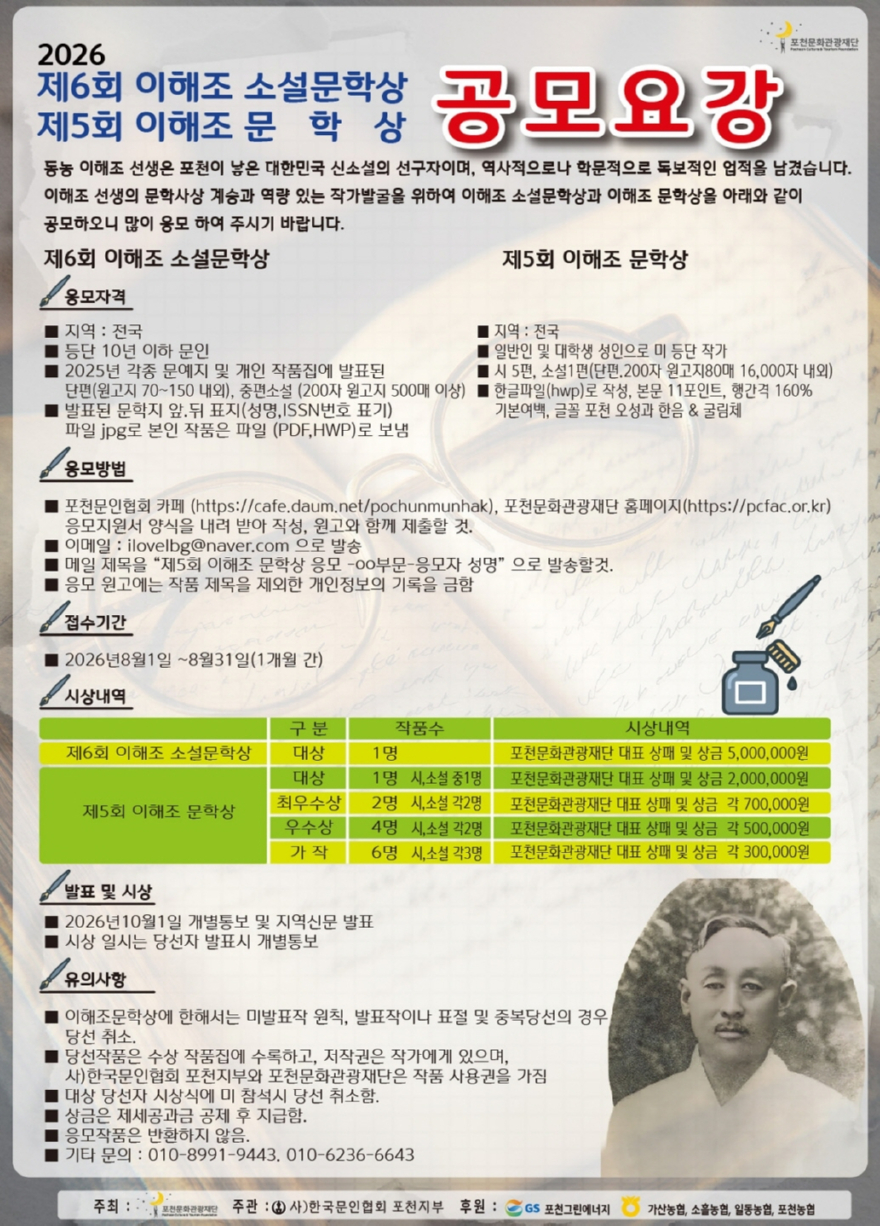
Pocheon’s 2026 Yi Hae-jo Literary Award proves that sustainable municipal dignity relies on cultivating living narratives alongside physical development.
In an age dominated by rapid consumption, the strength of a municipality is almost exclusively measured through concrete, quantifiable metrics. Public discourse eagerly fixates on the scale of new infrastructure, annual tourist counts, or the commercial success of seasonal festivals.
While these figures are undeniably important, a city's true cultural depth is rarely captured on a ledger. It is carved in sentences.
How a community preserves its historic memory, honors its literary pioneers, and nurtures new creative voices defines its character far more profoundly than asphalt ever can. In this context, the announcement of the 2026 Yi Hae-jo Literary Award by the Pocheon Cultural Tourism Foundation is far more than a routine contest call—it is a deliberate effort to anchor Pocheon’s modern identity in its deep literary roots.
◇ Echoes of the 'Liberty Bell': Pioneering the New Fiction
Though Dongnong Yi Hae-jo (1869–1927) may not be a household name to every casual reader, he remains a monumental figure in modern Korean literature. Born in Pocheon during the turbulent twilight of the Joseon Dynasty, Yi emerged as a seminal pioneer of Sinsoseol (New Fiction)—a transitional genre that bridged classical prose and modern narrative forms.
Yi did not view literature merely as passive entertainment. Amid the rapid shifts of the enlightenment era, he wielded narrative as a instrument for social awakening.
His celebrated work, Jajujong (Liberty Bell), utilized a structured debate format to critique societal stagnation, urge public enlightenment, and champion female consciousness at a time when women were largely excluded from public discourse. In bringing Yi Hae-jo back into the spotlight, Pocheon is reviving an intellectual legacy defined by courage, reform, and civic responsibility.
◇ From Static Monuments to a Living Literary Ecosystem
What makes Pocheon’s initiative particularly compelling is its refusal to treat heritage as a static monument. Too often, municipal cultural projects reduce historic figures to passive memorials—placing statues in parks while losing touch with contemporary relevance.
The Yi Hae-jo Literary Award takes the opposite approach. Hosted by the Pocheon Cultural Tourism Foundation and organized by the Pocheon Branch of the Korean Writers’ Association, the award actively invites living authors to step onto the stage:
By opening doors to both established authors and unpublished talents across the nation, Pocheon is not merely preserving past glory; it is actively stimulating a living literary ecosystem.
◇ Storytelling as the Ultimate City Brand
There is a strategic municipal wisdom in this approach. City branding often focuses on visual tourism, yet the most enduring city brands are anchored in narrative.
A scenic view attracts a fleeting photo-op, but a compelling story captures the imagination long after the journey ends. Travelers may glance at a landmark once, but they remember a city that holds literary resonance. By projecting Yi Hae-jo’s legacy onto a national stage, Pocheon converts its physical landscape into a "readable space"—a city defined by intellectual character rather than transit stopovers.
"A landscape captures the eye for a moment, but a story anchors a city in the human heart forever."
◇ The Beautiful Inefficiency of the Written Word
To a pragmatic observer, literature can look like an inefficient art form. Writing a story does not instantly pave a road, erect a commercial building, or double hotel occupancy overnight.
Yet, the long-term resilience of a city springs precisely from accumulating these quiet, intellectual assets. When people recall a city not just as a dot on a map, but through the lens of a great writer, a timeless book, or a memorable sentence, that city ascends to a different plane of cultural relevance. Literature may not make a city flashy, but it makes it deep.
Pocheon’s call for submissions under the name of Yi Hae-jo is a quiet, sophisticated statement of civic intent. As original manuscripts arrive from across the country this August, some will mark the brave debut of an emerging writer; others will deepen the cultural pride of the region. Ultimately, these sentences will weave together to ensure that Pocheon remains not just a place to visit, but a city to be read, remembered, and cherished.
BEST 뉴스
-

경민고 총동문회 골프팀 SBS골프 고교골프최강전 4강 진출 쾌거 10월 13일 준결승 격돌
경민고 총동문회 골프팀 SBS골프 고교골프최강전 4강 진출 쾌거 10월 13일 준결승 격돌 경민고등학교 총동문회 골프팀이 SBS골프 고교골프최강전 8강전에서 승리를 거두며 당당히 4강 진출의 쾌거를 달성했다. 전국 각지의 명문 고교 동문들이 출전해 모교의 명예와 장학금을 걸고 맞붙... -

가을 정취 물들이는 허브아일랜드 관광객을 위한 음악회 성황
가을 정취 물들이는 허브아일랜드 관광객을 위한 음악회 성황 가수 김용국 김봉규 단장의 색소폰 연주 가수 화영,황용 등 다채로운 무대 선사 가을 정취를 더하는 허브아일랜드 관광객을 위한 음악회가 열려 방문객들의 큰 호응을 얻고 있다. 트리플에이픽쳐스와 허브아일랜드... -

글로벌문화교류연합회 MOU 협약식 및 임명장 수여식 국회서 17일 개최
글로벌문화교류연합회 MOU 협약식 및 임명장 수여식 국회서 17일 개최 글로벌문화교류연합회와 장경태 의원실이 공동으로 주최하는 글로벌 문화교류 및 상호협력 활성화를 위한 MOU 협약식 및 임명장 수여식이 다가오는 10월 17일 토요일 14시부터 17시까지 국회 제8간담회의실에서 성대하게 열린다. 글로벌... -

포천 허브아일랜드 핑크뮬리 축제와 야간개장으로 가을맞이 본격화
포천 허브아일랜드 핑크뮬리 축제와 야간개장으로 가을맞이 본격화 경기 포천시 대표 관광지인 허브아일랜드가 가을 시즌을 맞아 핑크뮬리 축제 개막과 함께 야간개장을 본격적으로 운영하며 방문객 맞이에 나섰다. 허브아일랜드는 지난 9월 19일부터 가을 대표 축제인 핑크뮬리 축제를 시작했다. 스카이 허... -

제16회 계룡군문화축제 10월 1일 화려한 개막
제16회 계룡군문화축제 10월 1일 화려한 개막 대한민국 대표 군문화 축제인 제16회 계룡군문화축제가 오는 10월 1일부터 5일까지 5일간 계룡대 활주로 일대에서 펼쳐진다. 10월 1일 개막식은 오후 6시 30분 미8군 군악대 등의 식전공연을 시작으로 막을 올린다. 이어 오후 7시부터는 소향과 포레스텔라의... -

도쿄 번호판 달고 DMZ까지… 일본 경형 로드스터 고성 통일전망대 주차장 포착
도쿄 번호판 달고 DMZ까지… 일본 경형 로드스터 고성 통일전망대 주차장 포착 29일 오전 강원도 고성군 통일전망대 주차장에 일본 현지 번호판을 부착한 경형 오픈카 한 대가 주차되어 있어 관광객들의 눈길을 사로잡았다. 해당 차량은 일본 다이하츠 사의 2인승 경형 하드탑 컨버터블인 '코펜 세로' 모델로...
전체댓글 0
실시간뉴스


![[헤드라인] 아시아 최초 림팩 연합사령관 임무 수행, 대한민국 해군 위상 드높인다](/data/news/202607/news_1783140948.1.jpg)

추천뉴스






의정부시
more +단체
more +-

금감원 공시 개편에 삼천당제약 ‘프로핏 쉐어’ 재평가… ‘진가’ 고개를 들다
금융감독원이 제약·바이오 기업의 공시 체계를 전면 개편하고 계약금과 마일스톤, 로열티 및 이익배분 ... -

포천 신북면 ‘포담장터’ 7월 11일 개장… 먹거리·공연·나눔밥상까지 풍성
경기 포천시 신북면에서 지역 주민과 관광객이 함께 즐길 수 있는 먹거리 장터가 열린다. 포천 신북면 ... -
![[메트로기획] 붓끝에 되살린 소동파의 철학](/data/news/202607/news_1783652004.1.jpg)
[메트로기획] 붓끝에 되살린 소동파의 철학
소동파(蘇軾)의 대표 산문 〈전적벽부(前赤壁賦)〉가 이종훈 포천문화원장의 필치로 대형 서예 작품으... -
![[메트로기획] 모수국과 무지랭이골에 대한 연구 ①](/data/news/202607/news_1783613916.1.jpg)
[메트로기획] 모수국과 무지랭이골에 대한 연구 ①
경기 의정부시 고산주민센터에서 진행하는 치매예방 프로그램 ‘웃음빵빵 두뇌짱짱’ 수업 시간이었다. ...
포토뉴스
more +-

90세 노모가 입혀준 붉은 점퍼 소통과 효심으로 그리는 포천의 미래
90세 노모가 입혀준 붉은 점퍼 소통과 효심으로 그리는 포천의 미래 정치인의 선거복은 흔히 당적을 상징하지만 백영현 포천시장 후보에게 붉은 점퍼는 그 이상의 특별한 의미를 지닌다. 최근 90세 노모가 아들에게 직접 선거 운동복을 입혀주는 모습이 포착되면서 지역 사회에 잔잔한 감동을 전하고 ... -

국민의힘, 포천 시의원 선거 ‘위기론’ 확산... 승부수는 ‘필승 전략공천’
국민의힘, 포천 시의원 선거 ‘위기론’ 확산... 승부수는 ‘필승 전략공천’ 가선거구 서과석·나선거구 안애경 전면 배치설... 박윤경 후보 비례대표 선회론도 ‘솔솔’ 오는 6월 3일 제9회 전국동시지방선거를 앞두고 포천 지역 국민의힘 진영 내에서 위기감이 고조되고 있다. 선거 판세가 안개 속으... -

임종훈 포천시의장, '험로' 무소속 시의원 3선 도전...
"포천 향한 진심으로 승부" 임종훈 포천시의회 의장이 다가오는 지방선거에서 포천시장 출마 대신 '무소속으로 시의원 3선 재도전'이라는 파격적인 행보를 결정하며 지역 정가의 이목을 집중시키고 있다.그동안 유력한 시장 후보군으로 거론되며 체급을 키워온 임 의장의 이번 결정은 정치적 영달을 위한 '높... -
가을 정취 물들이는 허브아일랜드 관광객을 위한 음악회 성황
가을 정취 물들이는 허브아일랜드 관광객을 위한 음악회 성황 가수 김용국 김봉규 단장의 색소폰 연주 가수 화영,황용 등 다채로운 무대 선사 가을 정취를 더하는 허브아일랜드 관광객을 위한 음악회가 열려 방문객들의 큰 호응을 얻고 있다. 트리플에이픽쳐스와 허브아일랜드가 주최 주관하고 포천...
