


- Pocheon City’s public lecture on child mental health reframes parenting priorities, proving that emotional self-governance is the true foundation of long-term human stamina.
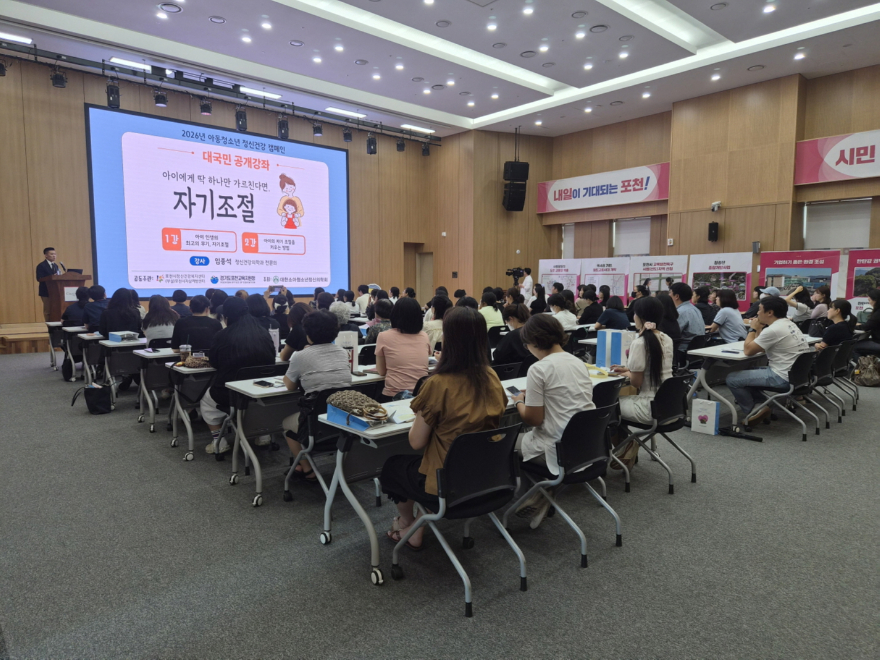
In today’s hyper-competitive educational landscape, parental daily life is dictated by a relentless drumbeat of urgency: How can my child learn faster? What extra skills should they acquire? How can they outpace their peers?
Amid this frantic pursuit of external achievement, a fundamental question is frequently pushed into the background: Are our children learning how to navigate their own emotions, control their impulses, endure frustration, and calibrate their behavior within relationships?
In this context, Pocheon City’s recent public lecture on child and adolescent mental health—centered on the provocative premise, "If You Could Teach a Child Just One Thing, Make It Self-Regulation"—strikes a deeply resonant chord. It invites parents and educators to step back from the mechanics of competition and re-examine the foundational stamina required for a human life to flourish.
◇ The Architecture of Self-Governance
Self-regulation sounds deceptively simple on the surface, but it represents the structural backbone of long-term character.
While academic brilliance, eloquence, and precocious talent are undeniably valuable, they are ultimately fragile without the internal capacity to govern oneself. Far more decisive in the long run are the quiet, enduring strengths:
Emotional Calibrating: Controlling explosive anger in moments of conflict;
Delayed Gratification: Resisting immediate impulses to pursue long-term goals;
Psychological Resilience: Bouncing back from failure without collapsing into despair;
Relational Flexibility: Navigating interpersonal friction through dialogue rather than emotional volatility.
At its core, self-regulation is the art of self-mastery—and it remains one of the few competencies whose impact echoes through every stage of an individual’s life.
◇ A Basic Survival Skill in a Hyper-Stimulated World
The urgency of this topic is heightened by the sensory environment in which modern children grow up. Digital media has normalized instant feedback loops and shortened attention spans, while constant social comparison and information overload make emotional equilibrium increasingly difficult to maintain.
When academic pressure and social anxiety are layered on top of this hyper-stimulated environment, regulating one's own thoughts and actions ceases to be an optional virtue. It becomes an essential survival skill for modern life.
Importantly, self-regulation is not an innate trait that can be summoned by parental decree. Mandates like "Calm down," "Stop throwing a tantrum," or "Why can't you focus?" rarely yield genuine self-control.
Children learn emotional regulation by observing the adult environment around them. The foundation of a child's internal compass is shaped by how parents respond when tensions flare, whether mistakes are met with constructive guidance or harsh criticism, and whether boundaries are maintained with consistent empathy. Children learn from a parent's attitude long before they absorb their words.
◇ Mental Health as Community Infrastructure
The presence of over 100 participants at the lecture—ranging from parents and schoolteachers to social workers and local residents—underscores another crucial reality: raising emotionally grounded children is a collective responsibility.
A child cannot develop emotional stability in a vacuum. If home, school, and community operate on contradictory expectations, or if emotional struggles are dismissed as individual flaws, a young person’s internal equilibrium will inevitably falter.
"A city's livability is not defined solely by its paved roads or industrial complexes; it is measured by whether parents feel supported and whether the community is equipped to nurture the emotional well-being of its youth."
Pocheon’s decision to address child and adolescent mental health as a core municipal priority reflects a mature understanding of urban livability. A city seeking to attract and retain families cannot offer a complete vision of the future without ensuring that its youngest citizens feel emotionally safe and supported.
◇ The Most Enduring Weapon for Life
Naturally, a single public lecture will not transform family dynamics overnight. The true measure of this initiative lies in its integration into a broader, continuous framework—connecting parental workshops, teacher training, early intervention programs, and clinical counseling networks across the region.
When we consider what children truly need to thrive in an unpredictable world, the most decisive strengths are rarely the most flashy. Long-term fulfillment belongs not to those who merely run fastest out of the gate, but to those who possess the internal compass to stay grounded when storms arise.
Self-regulation is precisely that kind of quiet strength. By teaching children how to manage their inner worlds before urging them to conquer the outer world, Pocheon City is offering its youth the most protective, enduring gift possible: the ability to hold onto themselves, no matter what lies ahead.
BEST 뉴스
-

경민고 총동문회 골프팀 SBS골프 고교골프최강전 4강 진출 쾌거 10월 13일 준결승 격돌
경민고 총동문회 골프팀 SBS골프 고교골프최강전 4강 진출 쾌거 10월 13일 준결승 격돌 경민고등학교 총동문회 골프팀이 SBS골프 고교골프최강전 8강전에서 승리를 거두며 당당히 4강 진출의 쾌거를 달성했다. 전국 각지의 명문 고교 동문들이 출전해 모교의 명예와 장학금을 걸고 맞붙... -

가을 정취 물들이는 허브아일랜드 관광객을 위한 음악회 성황
가을 정취 물들이는 허브아일랜드 관광객을 위한 음악회 성황 가수 김용국 김봉규 단장의 색소폰 연주 가수 화영,황용 등 다채로운 무대 선사 가을 정취를 더하는 허브아일랜드 관광객을 위한 음악회가 열려 방문객들의 큰 호응을 얻고 있다. 트리플에이픽쳐스와 허브아일랜드... -

글로벌문화교류연합회 MOU 협약식 및 임명장 수여식 국회서 17일 개최
글로벌문화교류연합회 MOU 협약식 및 임명장 수여식 국회서 17일 개최 글로벌문화교류연합회와 장경태 의원실이 공동으로 주최하는 글로벌 문화교류 및 상호협력 활성화를 위한 MOU 협약식 및 임명장 수여식이 다가오는 10월 17일 토요일 14시부터 17시까지 국회 제8간담회의실에서 성대하게 열린다. 글로벌... -

포천 허브아일랜드 핑크뮬리 축제와 야간개장으로 가을맞이 본격화
포천 허브아일랜드 핑크뮬리 축제와 야간개장으로 가을맞이 본격화 경기 포천시 대표 관광지인 허브아일랜드가 가을 시즌을 맞아 핑크뮬리 축제 개막과 함께 야간개장을 본격적으로 운영하며 방문객 맞이에 나섰다. 허브아일랜드는 지난 9월 19일부터 가을 대표 축제인 핑크뮬리 축제를 시작했다. 스카이 허... -

제16회 계룡군문화축제 10월 1일 화려한 개막
제16회 계룡군문화축제 10월 1일 화려한 개막 대한민국 대표 군문화 축제인 제16회 계룡군문화축제가 오는 10월 1일부터 5일까지 5일간 계룡대 활주로 일대에서 펼쳐진다. 10월 1일 개막식은 오후 6시 30분 미8군 군악대 등의 식전공연을 시작으로 막을 올린다. 이어 오후 7시부터는 소향과 포레스텔라의... -

도쿄 번호판 달고 DMZ까지… 일본 경형 로드스터 고성 통일전망대 주차장 포착
도쿄 번호판 달고 DMZ까지… 일본 경형 로드스터 고성 통일전망대 주차장 포착 29일 오전 강원도 고성군 통일전망대 주차장에 일본 현지 번호판을 부착한 경형 오픈카 한 대가 주차되어 있어 관광객들의 눈길을 사로잡았다. 해당 차량은 일본 다이하츠 사의 2인승 경형 하드탑 컨버터블인 '코펜 세로' 모델로...
전체댓글 0
실시간뉴스


![[헤드라인] 아시아 최초 림팩 연합사령관 임무 수행, 대한민국 해군 위상 드높인다](/data/news/202607/news_1783140948.1.jpg)

추천뉴스






의정부시
more +단체
more +-

금감원 공시 개편에 삼천당제약 ‘프로핏 쉐어’ 재평가… ‘진가’ 고개를 들다
금융감독원이 제약·바이오 기업의 공시 체계를 전면 개편하고 계약금과 마일스톤, 로열티 및 이익배분 ... -

포천 신북면 ‘포담장터’ 7월 11일 개장… 먹거리·공연·나눔밥상까지 풍성
경기 포천시 신북면에서 지역 주민과 관광객이 함께 즐길 수 있는 먹거리 장터가 열린다. 포천 신북면 ... -
![[메트로기획] 붓끝에 되살린 소동파의 철학](/data/news/202607/news_1783652004.1.jpg)
[메트로기획] 붓끝에 되살린 소동파의 철학
소동파(蘇軾)의 대표 산문 〈전적벽부(前赤壁賦)〉가 이종훈 포천문화원장의 필치로 대형 서예 작품으... -
![[메트로기획] 모수국과 무지랭이골에 대한 연구 ①](/data/news/202607/news_1783613916.1.jpg)
[메트로기획] 모수국과 무지랭이골에 대한 연구 ①
경기 의정부시 고산주민센터에서 진행하는 치매예방 프로그램 ‘웃음빵빵 두뇌짱짱’ 수업 시간이었다. ...
포토뉴스
more +-

90세 노모가 입혀준 붉은 점퍼 소통과 효심으로 그리는 포천의 미래
90세 노모가 입혀준 붉은 점퍼 소통과 효심으로 그리는 포천의 미래 정치인의 선거복은 흔히 당적을 상징하지만 백영현 포천시장 후보에게 붉은 점퍼는 그 이상의 특별한 의미를 지닌다. 최근 90세 노모가 아들에게 직접 선거 운동복을 입혀주는 모습이 포착되면서 지역 사회에 잔잔한 감동을 전하고 ... -

국민의힘, 포천 시의원 선거 ‘위기론’ 확산... 승부수는 ‘필승 전략공천’
국민의힘, 포천 시의원 선거 ‘위기론’ 확산... 승부수는 ‘필승 전략공천’ 가선거구 서과석·나선거구 안애경 전면 배치설... 박윤경 후보 비례대표 선회론도 ‘솔솔’ 오는 6월 3일 제9회 전국동시지방선거를 앞두고 포천 지역 국민의힘 진영 내에서 위기감이 고조되고 있다. 선거 판세가 안개 속으... -

임종훈 포천시의장, '험로' 무소속 시의원 3선 도전...
"포천 향한 진심으로 승부" 임종훈 포천시의회 의장이 다가오는 지방선거에서 포천시장 출마 대신 '무소속으로 시의원 3선 재도전'이라는 파격적인 행보를 결정하며 지역 정가의 이목을 집중시키고 있다.그동안 유력한 시장 후보군으로 거론되며 체급을 키워온 임 의장의 이번 결정은 정치적 영달을 위한 '높... -
가을 정취 물들이는 허브아일랜드 관광객을 위한 음악회 성황
가을 정취 물들이는 허브아일랜드 관광객을 위한 음악회 성황 가수 김용국 김봉규 단장의 색소폰 연주 가수 화영,황용 등 다채로운 무대 선사 가을 정취를 더하는 허브아일랜드 관광객을 위한 음악회가 열려 방문객들의 큰 호응을 얻고 있다. 트리플에이픽쳐스와 허브아일랜드가 주최 주관하고 포천...
